Translate

Showing posts with label garden. Show all posts

Thursday, July 11, 2013

Rainy Days Pollination Blues!


 Guest post by David L. Green, retired commercial bee keeper, former editor of small newspaper, teacher. You can visit his website and his blog

Partially pollinated cucumbers. © Dave Green, 2013

With seven inches of rain in five days, bees had very little time to work. They delivered enough pollen grains so that the cucumbers did not abort, but not enough to flesh them out.

The one at left is a total lack of fertilization of the seeds at one end - that meant that the flesh did not grow, and the cuke had a "tail." Three more are slightly better. The one at the bottom has few of the incipient seeds fertilized in the middle, giving a waist to the cuke. These poorly pollinated cukes grow slowly and quickly get tough, sometimes bitter, as well.

If bee populations are normal, this problem should straighten out when the weather is more suited to bee flight. If you get very many like this in good pollination weather, you have a shortage of bees, and may need to work on increasing bee populations or hand pollinate.

My garden is pollinated by a mix of bees, with the bulk of the workload carried by bumblebees and honey bees, but we also have green sweat bees, squash bees, digger (Anthophora) bees, tiny Ceratina bees, and leaf cutter bees doing some of that work.

To make a perfect cucumber, you need to get almost all of the incipient seeds fertilized. That requires two grains of pollen - one for the embryo and one for the seed coat, so each perfectly pollinated cuke represents several hundred grains of pollen delivered to the flower.

A lot of folks think that, if they see a bee in a flower, that pollination is accomplished. But it's not an on/off switch. It's a progressive thing. It takes many bee visits to deliver all the pollen needed for multi-seeded fruits.

Every year, more and more gardeners report the symptoms of lack of pollination in their gardens. The problem seems to be accelerating.

It represents one of our most urgent environmental problems - pollinator decline. Our bees are disappearing. Some of that is due to habitat loss; some due to monoculture and its feast or famine pattern of intense bloom, followed by barrenness; some is from new diseases and parasites; but the worst and most difficult problem to solve is the loss caused by pesticides.

When cotton blooms, bees focus on those nectar-rich blossoms, and drop by the millions when the cotton is sprayed. In July clover is in full bloom in the orchard floor, and more millions of bees die when the fruit is sprayed. Community mosquito sprays are supposed to be applied when bees are not working, but this time limit is very poorly observed, and many more bees are dropped from applications done when they are out. And many gardeners plaster Sevin dust all over their gardens without thought of the bees.

All four of these cases I mentioned are illegal applications, because the label directions forbid them, but label enforcement is rare and usually amounts to a slap on the wrist, if anything.

So, if we do not begin to protect our pollinators - we lose much of the vitamin C (fruits) in our diet. Food costs will rise; only the rich will be able to afford many of the most nutrient-rich foods we have. We are left with grains that do not need bees - but remember that "man shall not live by bread alone."

© Dave Green, 2013
Retired pollination contractor


Sunday, October 10, 2010

Lawn for Pollinators. Part III


As mentioned many times before, it is preferable to have a wildflower meadow than a large expanse of lawn; however, some areas need to be mowed to allow walking on them or to enhance the garden. Grass companions, plants that are good to pollinators and to wildlife in general are welcome in such areas. They are healthy for the lawn, can be quite pleasant to look at and can provide food for many types of wildlife including bees, butterflies and birds.


One grass companion that is good in the fall is the aster, or several species of asters. Their pretty, daisy like flowers add a sparkle to the uninterrupted greenness. The genus Aster is rich in species; some of them are so similar that even botanists have trouble telling them apart. Many are used in wildflower gardens and wildflower meadows; they can be too tall to become part of a lawn; a few manage to escape the meadow and survive repeated mowings, growing very low and close to the ground. Thus they become grass companions.


Here is a field where asters are interspersed with the grass; if mowing isn’t too frequent they manage to grow several inches tall and to produce many flowers in September and October. If the lawn receives more frequent mowings the plants hug the ground and still produce a pleasant array of little flowers. Finally if the lawn is mowed closer to the ground and with higher frequency the asters may fail to bloom, but they still provide a nice ground cover, green, thick and supple.

Such flowers don’t fail to attract a considerable number of pollinators; I see them in abundance when I walk through a field where asters are accepted as part of the lawn. Skippers are very common visitors; other flashier butterflies, such as fritillaries and buckeyes, also show up.


A variety of Syrphid flies or hover flies come to visit the aster blooms. They may not be very efficient pollinators but they perform another very important function: their babies devour aphids; so they are welcome visitors in any garden.


Finally, some of the most important pollinators come to the asters: many sorts of bees, among them the beleaguered honey bees, several types of bumble bees and a few other native bees of the solitary type.


Update, 2013: Many species of native asters are now in the genus Symphyotrichum.

Lawn for pollinators. Part I
Lawn for pollinators. II

List of articles

© Beatriz Moisset. 2012

Saturday, April 24, 2010

Lawn for Pollinators. Part II

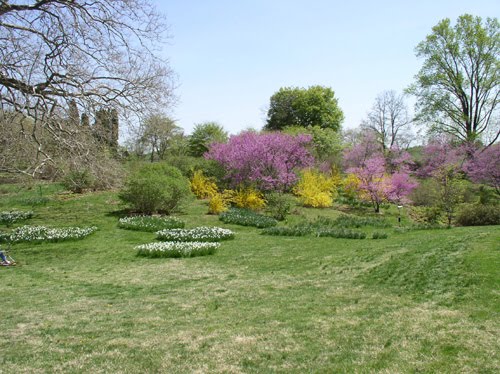
Winterthur in the Brandywine Valley near Philadelphia. Large expanses of lawn such as these are being turned into meadows with paths rambling through them.

We have covered an astronomical number of square miles with lawns, lawns that are in most cases deserts, useless to wildlife. That surface is comparable to that of Pennsylvania, New Jersey, Delaware, Maryland and Rhode Island combined.

If you live in the West you may prefer to see this surface as equivalent to that of the state of Washington.

Do we need that much lawn? Much of it could be turned to meadows or other plantings according to the mantra: "Less lawn, less mowing, less pollutants, more natives". This is being done in places such as the New River Gorge National Park Visitors Center in West Virginia. The meadows and grassy paths are pleasant to the eye, beneficial to wildlife and healthier for everybody.

New River Gorge Bridge Visitor Center. WV

Lawn for pollinators. Part I
Lawns for pollinators. Part III

List of articles

© Beatriz Moisset. 2012

Sunday, April 4, 2010

Lawn for Pollinators. Grass Companions

Yellow violet
Ordinarily a lawn is a desert, very unwelcoming to wildlife from tiny insects to birds. It doesn't have to be this way. A lawn can supply food for pollinators and even for birds; it can also provide housing for some pollinators.

We can make our lawns more nature-friendly by readjusting our notions of aesthetics: a perfectly manicured lawn that looks like an indoor green carpet need not be the only ideal of lawn beauty. Instead, a lawn with some variety of plants which includes a few broad-leaved “weeds” has its own kind of natural beauty; let us call them “grass companions.”

The very first step, naturally, is to avoid insecticides and herbicides whenever possible. The choice of broad-leaved small plants that you can allow in your lawn is a little trickier and it may take some time to get the right combination; but the final product would be a pleasant lawn that requires less care and less fertilizing, providing more resilience to droughts and pests in addition to being more hospitable to desirable wildlife. There are a number of little flowering plants that grow in lawns completely uninvited that we are constantly trying to eradicate; however we could start welcoming some of them.

Ideally, you want only non-invasive lawn flowers, preferably native ones, but this would require effort beyond that which many gardener would be willing to invest. So it is understandable when gardeners accept some non-natives; after all most lawns are made up of grasses which may not be native to your region.

Some of my favorite grass companions, such as violets, bluets and spring beauties do well only where foot traffic is minimal, or where mowing is less frequent. Others can take a good amount of abuse:

Bluets
• Blue eyed grasses (Sisyrinchium, several species) not a true grass but a member of the iris family, with pretty blue flowers.
• Cinquefoils, (Potentilla).
• Wild strawberries (Fragaria, several species). The five lobed leaves of this and those of cinquefoils are very similar in appearance.
• Yellow violets (Viola pennsylvanica), and other kinds of violets too.
• Spring beauties (Claytonia)
• Wild geraniums, crane’s-bills (Geranium)
• Azure bluets (Houstonia caerulea).
• Speedwells (Veronica), there are several species, some of them are native others introduced.
• Wood sorrel (Oxalis acetosella), used as ground cover by some gardeners.
• Chickweeds include two genera: Cerastium and Stellaria. They are also known by several other common names; some species are native and small enough to do well in lawns, such as field chickweed, (Cerastium arvense) and star chickweed (Stellaria pubera).
• Smartweeds, knotweeds, many species in the genus Polygonum; some are small enough to do well in lawns. Some species are native and others introduced.
Asters (Symphyotrichum) are great in the fall. Some grow rather tall, better for a meadow than a lawn; but if mowed not too frequently, they can do well and bloom heavily inviting many species of pollinators.

Among the non-natives, a very useful one is clover, (white clover, Trifolium repens) a European plant very well established in the United States; it used to be included in grass seed mixes because it helps fix nitrogen, enriching the soil as a consequence. There are a few species of clover that are native to some regions of North America. Chickweeds, also known as starweed, bindweed, winterweed, as mentioned above some are native others aren’t; the seeds of some are eaten by some birds, hence the name chickweed. Gill over the ground, or ground ivy (Glechoma hederacea), is rather pretty but it can be very invasive. Thyme, (Thymus several species) has been used as ground cover sometimes. Scarlet pimpernel, (Anagalis arvensis) a European plant with small pink flowers. Dandelion (Taraxacum officinale) is among the non-native invasives which you may not want to see around. Some think that it doesn't provide much of anything to pollinators despite its colorful flowers, others fear that it may compete for pollinators with some native flowers, reducing their pollination.

Chickweed
These are just a few of the "grass companions" that do well in my region, the Mid Atlantic. Other areas might use some of the same along with other “companions” based on regional conditions.

A simple practice that can be helpful to pollinators in your lawn is to allow some bare spots in dry and sunny places that can be used for nesting by bees and some insect eating wasps. Some leaf litter, especially on or near flower beds, can provide shelter for fritillary caterpillars and hummingbird moth caterpillars and a few other wintering moths and butterflies.
Asters

Lawn for pollinators, part II
Lawn for pollinators, part III

List of articles
Beginners Guide to Pollinators and Other Flower Visitors

© Beatriz Moisset. 2010