Translate

Showing posts with label moth. Show all posts

Monday, November 14, 2016

It is Cold Outside. Where did all the Butterflies Go?

Great spangled fritillary (Speyeria cybele)
Its tiny caterpillars will survive the winter
© Beatriz Moisset
Winter has arrived. What happened to all the six legged creatures we saw in summer? Where did the crawling, scuttling, flitting, buzzing multitudes go? Those of us who live in temperate and colder climates notice the disappearance of practically all insects when the weather gets cold. We are talking about the ones that live outdoors, not about those aggravating creatures that turn our houses into their homes.

Red admiral (Vanessa atalanta), one of the travelers
© Beatriz Moisset
Some of our favorite butterflies illustrate three different winter strategies.
1. Most adult butterflies die, the next generation lives on
2. A few migrate to warmer climates
3. Even fewer hunker down and wait for spring to come

Read the whole article

List of articles
Beginners Guide to Pollinators and Other Flower Visitors

© Beatriz Moisset. 2016
 

Wednesday, May 11, 2016

Too Much Light!

Outdoor light
Most of it is wasted, aiming to the skies
© Beatriz Moisset

Could it be that we have too many outdoor lights? Night lights have become so abundant that they can be seen from space. Large cities are beacons made of myriads of tiny dots of light. The planet has never seen anything like it before. We know the benefits of good illuminated streets and public areas. Could there be some drawbacks too?

For one thing, we have lost the ability to see the night sky in all its splendor. Most stars have become invisible to city dwellers. Even in the suburbs and some distance from large cities, lights affect our vision of the sky. Astronomers regret this deeply and have some suggestions on how to mitigate the impact of night lights.

Night lights have other effects worth discussing. We all know that moths are attracted to lights. We often see a handful of them flying aimlessly around our porch lights or finally settling on a wall for the rest of the night. They are still there the next morning and remain still for the day since they are not day fliers.

How does this affect moths? Undoubtedly, such behavior may cost some of them their lives by exhaustion and lack of food. Does it matter?

Many moths are pollinators of night flowers. Nature is rich in its approaches to issues. Although most flowers bloom and are pollinated during the day, preferably when the sun is shining, a few take advantage of the darkness of dawn and dusk and even the middle of the night. Thus, they take advantage of certain flower visitors that have developed a similar strategy, namely being active at night.

Thyatira lorata moth
Attracted to night lights and
spending the day where it finally rested
© Beatriz Moisset
This is how a partnership has developed between some flowers and nocturnal moths. Ordinarily, such flowers are white or cream colored and have strong scents, better to attract their pollinators. Moths, in turn, have good night vision and a strong sense of smell.

Getting back to light pollution, if it kills moths, it too may be affecting the pollination of night blooms. We don't know this for sure, but there are strong indications that this is the case. Also some evidence points to night lights affecting the growth of some plants by getting their schedule confused.

We should follow the suggestions provided by several websites on how to minimize light pollution, for instance the Florida AtlanticUniversity website covers a lot of ground. One useful recommendation is "no light should be emitted above the source's horizontal plane."

The Mother Nature Network lists five ways you can reduce light pollution:
  1. Start with the light switch
  2. Check with your power company to see if you're paying for outdoor lighting
  3. Consider replacing outdoor lights with intelligently designed, low-glare fixtures
  4. Place motion sensors on essential outdoor lamps
  5. Replace conventional high-energy bulbs with efficient outdoor CFLs and LED floodlights
However most of these ideas, although excellent provide no significant protection to pollinators and their plants. For this purpose one valuable tip is to abstain from lighting the landscape. There is no real need to illuminate your trees, shrubs and the general area where they grow, so let us give up this kind of lighting, please.

Virginian tiger moth
© Beatriz Moisset


Wednesday, March 18, 2015

Mass Appeal and Pollination


Some of the many visitors to goldenrod.  © Beatriz Moisset

Many flowers are not particularly selective; they welcome all kinds of visitors. They are wide open, easily accessible, thus many insects can reach the nectar and/or pollen regardless of whether their tongues are long or short. Such flowers provide a convenient standing platform to save their visitors the inconvenience of hovering over them. Their structure is simple so the pollinators don’t need to figure out how to open them in order to reach their rewards. Goldenrod is a fine example.
Monarch butterfly on goldenrod. © Beatriz Moisset
 I have spent countless happy hours observing goldenrods and photographing their numerous visitors. The one most common in my area is the Canada goldenrod. Several hundreds of species visit their flowers. Bear in mind that not all flower visitors qualify as pollinators. Some are not efficient at carrying pollen, or sit in one place for a long time and never make it to another plant. Such is the case of ambush bugs, whose only concern is to snare hapless pollinators to make a meal out of them. If you are interested on photographing and identifying pollinators this is a good place to start.

Metallic green bee. © Beatriz Moisset
 This plant blooms in the fall. It often gets blamed for allergies, but the real culprit is another plant that grows close by, sometimes intermingled with goldenrods, ragweed. Its flowers are inconspicuous because its pollen gets carried by the wind, not by officious pollinators. This is how it gets into our nostrils and causes our suffering. The much maligned goldenrods have larger, heavier and stickier grains of pollen that cannot get airborne and that require help from visitors.

Two states, Kentucky and Nebraska, have the goldenrod as their state flower. It is not clear which species of goldenrod Kentucky picked, but it is likely the Canada goldenrod (Solidago altissima). Nebraska’s choice is clearer, the giant goldenrod (Solidago gigantea). South Carolina, not satisfied with a state flower, also has a state wildflower. It is the Canada goldenrod. It is worth mentioning that Delaware has a state herb, the anise-scented or sweet goldenrod (Solidago odora).

Bumble bee on sunflower. © Beatriz Moisset

Coreopsis. © Beatriz Moisset
 Two other state flowers also have mass appeal. Like goldenrod, they are members of the daisy or aster family, easy to access by different kinds of visitors. They are Kansas’ sunflower (Helianthus annuus) and Maryland’s Black-eyed Susan (Rudbeckia hirta). It is worth mentioning here that two states, Florida and Mississippi, chose the tickseed (Coreopsis spp.) as a state wildflower in addition to their official state flowers, the orange blossom and the magnolia, respectively.

Kentucky: Goldenrod
Nebraska: Goldenrod
South Carolina (wildflower): Goldenrod
Delaware (herb): Goldenrod
Kansas: Sunflower
Maryland: Black-eyed Susan
Florida (wildflower): Coreopsis
Mississippi (wildflower): Coreopsis

The indiscriminate pollination strategy represented by all these flowers has advantages and also disadvantages. They suffer no shortage of pollinators. If one species is doing poorly one year, as it often happens in the insect world, there are plenty more to fill in the deficiency. However, sometimes too much of a good thing can be bad. Some of these non-specialized pollinators may be visiting a variety of flowers instead of being faithful to just one species so they end up carrying the wrong kind of pollen in such cases.

Blossoms with such mass appeal give me the opportunity to introduce the reader to the main groups of pollinators. They are all well represented on these mass appeal flowers.

Andrenidae bee © Beatriz Moisset
Bumble bee. © Beatriz Moisset
 Let us start by getting acquainted with bees. More than 80 species have been seen on goldenrods. Some of them deserve mention. Bumble bees are larger than other bees, plump, dark with yellow or white stripes, and hairy. Metallic green bees are small and gorgeously colored. They may escape notice if one isn’t very observant; but it is easy to become captivated by their shiny aspect. Mason bees and leaf-cutting bees carry pollen on their underbelly, unlike most other bees that carry it on their hind legs. Most of them are dark, nearly black and about the size of honey bees or slightly smaller.

Wasp. © Beatriz Moisset
 Wasps are related to bees and sometimes people confuse them. Most wasps are less hairy than bees and have narrow waists. They raise their young on a diet of insects or spiders, instead of pollen and nectar as bees do. Adult wasps need nectar to fuel their flight. Thus, they are frequent flower visitors and accomplish some pollination.

Syrphid fly. © Beatriz Moisset

Many types of flies, including mosquitoes and gnats visit flowers to feed on their nectar. Some are good pollinators. The Syrphid flies, also called flower flies, are among the most assiduous flower visitors. Most of them mimic bees or wasps and are frequently mistaken for them. However, they don’t sting and there is no reason to fear them.

Buckeye butterfly on goldenrod. © Beatriz Moisset
Pyrausta moth on sunflower. © Beatriz Moisset
Yellow collared scape moth on goldenrod. © Beatriz Moisset
 Butterflies, skippers and moths have extremely long tongues that they can use like drinking straws when sipping nectar. They favor long necked flowers and carry pollen from one to another.

Polished lady beetle on sunflower. © Beatriz Moisset
Soldier beetle on goldenrod. © Beatriz Moisset
Finally, beetles, although not well specialized for pollination, are also capable of doing so in special circumstances. We already mentioned magnolia pollination by beetles. They also visit other flowers and can do a reasonably good job in some cases.

In the following chapters we’ll see flowers that have chosen a different strategy. They are pickier or more selective. Some attract a handful of visitors; a few go to the extreme of having relationships with only one species of pollinators.

References

Sunday, January 12, 2014

Beginners Guide to Pollinators


Read the review by Kathy Keatley Garvey at the Bug Squad website, For Beginners, a Guide to Pollinators
So many flowers.  So many pollinators. So many floral visitors.
On every field trip, we see something new and different.
With so much interest in pollinators, it's good to see that biologist Beatriz Moisset has written a downloadable book, "A Beginners Guide to Pollinators and other Flower Visitors." It's meant for young adults and beginners.


Beginners Guide to Pollinators and other Flower Visitors available at:

Wednesday, May 30, 2012

Gardening for Honorary Butterflies (Mint Moths)


Not all moths fly at night and not all are drab. Some deserve the name of honorary butterflies. In fact sometimes they are mistaken for them. Sorry I tricked you by using the word butterflies in the title (not really); but I was afraid that most would ignore this article if they just saw the word moths. The fact is that there are ten times more species of moths than of butterflies; that they are very important components of ecosystems and worth welcoming in our gardens. Some are very beautiful and can give visual enjoyment to the gardener. To me, most if not all are beautiful each in its own way. But I know people who dislike, fear or hate moths in general. I hope that at least they take time to look and learn to love the pretty ones.

I will save some of the most striking ones, such as hummingbird, imperial and Luna moths for later. I will start with some that many people are unaware of and amazed when they first see them.

The crambid snout moths represent a family (Crambidae) with more than 850 species in North America. They get their common name from the appendage that sticks out on front of their heads. Some of them, the members of the genus Pyrausta feed on plants of the mint family, so I will be calling them mint moths, although they don't really have a common name. Most of them are brightly colored and are seen during the day.
Pyrausta orphisalis (Orange Mint Moth) on mountain mint
©Beatriz Moisset


The larvae of the orange mint moth (Pyrausta orphisalis) feed on a variety of mints and sometimes you cans see signs of their feeding, especially at the buds and newer leaves. But the damage is not known to reach serious proportions. It is good to remember that caterpillars are bird food. So it is a good idea to have a few well behaved caterpillars such as these ones to attract birds to the garden. It is also a pleasure to spot this very attractive moth resting on a plant of mint.

Pyrausta signatalis (Raspberry Pyrausta) on mint
©Beatriz Moisset


The raspberry mint pyrausta (Pyrausta signatalis) is also richly colored and earns its name because of the raspberry color of its wings. The larvae feed primarily on spotted beebalm (a member of the mint family), they also feed on a few related plants such as wild bergamot and scarlet beebalm.

Pyrausta tyralis
  © Bob in swamp Flickr
 Another member of this genus, even more striking in its coloration is the Coffee-loving pyrausta (Pyrausta tyralis). This one breaks the mold with its feeding habits, a peculiar feat. It gets its name because it likes wild coffee (Psychotria nervosa) found in Florida. It also feeds on some Asteraceae such as dahlia and bidens.

It is worth mentioning that there are many species of mint moths in Europe. Here is a gorgeous one: the golden mint moth (Pyrausta aurata).

Pyrausta aurata © Bramblejungle Flickr

In summary, if you want to attract these honorary butterflies to your garden plant a variety of mints including beebalm which by the way is also good at attracting hummingbird moths and hummingbirds.

Moth as Pollinators
List of articles
Beginners Guide to Pollinators and Other Flower Visitors

© Beatriz Moisset. 2012 

Saturday, March 31, 2012

The Yucca Moth and the Yucca

Yucca (Yucca glauca), the state flower of New Mexico, illustrates an intimate relationship between a specialized pollinator and its equally specialized flower. The plant and the insect co-evolved; that is, they developed in intimate connection with each other. This is called an obligate mutualism in which if one were to disappear, the other would follow the same path. Originally it was a relationship of exploitation, with the moth larvae feeding on the seeds of the yucca. But, eventually the plant devised methods to take advantage of the situation and as a consequence, the moth also evolved to ensure food for its babies and preservation of its food plant.

Yucca flowers open for a few days, attracting a variety of insects during day hours; but they produce more nectar and send their strong and sweet aroma at night. Flowers with these characteristics are usually pollinated by moths or other nocturnal pollinators.

The yucca adds a special embellishment to this arrangement; of all the insects that visit its flowers, the only ones that can accomplish pollination are the yucca moths (Tegeticula yuccasella and Parategeticula depending on the species of plant).

Yucca moths are small, white, not very noticeable. They spend a good part of their adult life inside the flowers of the yucca, meeting members of the opposite sex and mating. Once mating has taken place, the female, very purposely visits the male parts of the flowers (anthers) to collect pollen which she stores under her chin.

Later, she flies to another flower, inspects it carefully, and if no other female has deposited her eggs, she proceeds to do just that. She refrains from laying more than a small number of eggs. The larvae will feed on the seeds of the plant. She seems to know that if she gets carried away and lays too many eggs, the flower will abort rather than produce a seedless fruit. It would be a no win situation, both for the plant and the moth.

Then, just as purposely as before, she goes to the right place, at the top of the ovary (called stigma), and deposits some of her precious cargo of pollen from under her chin, ensuring, this way, that the seeds will grow and feed her babies. She repeats this operation in other flowers.

The larvae feed on some of the seeds and there are enough left for the plant to reproduce. When fully grown, the larvae drop to the ground, where it goes through the transformation called pupation and finally it emerges as an adult several months later to repeat the cycle.

Without this insignificant little moth, the landscapes of the west would look dramatically different in the absence of yucca.

© Cillas. Wikicommons
Read more:

Moths as Pollinators
List of articles
Beginners Guide to Pollinators and Other Flower Visitors

© Beatriz Moisset. 2012

Sunday, March 11, 2012

Zygaenidae, more little known pollinators

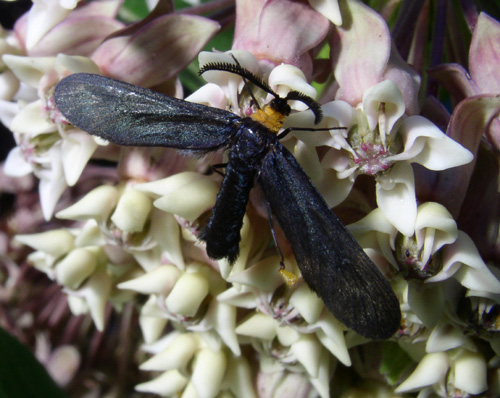
Harrisina americana (Grapeleaf Skeletonizer) on common milkweed

Another family of moths with a number of species that visit flowers is Zygaenidae. Many of them are day flying moths and, as usual, they are more colorful than night flying ones. Some are known to pollinate orchids. Their larvae feed on foliage, eating everything but the veins of leaves, so one common name for them is leaf-skeletonizers.
Acoloithus falsarius (Clemens' False Skeletonizer)

Two of them are frequently seen on milkweed flowers, the grapeleaf skeletonizer and Clemen's false skeletonizer. They are both dark blue or blue gray with a bright orange collar. The Clemen's moth is smaller than the grapeleaf skeletonizer. What is interesting about this imitative pattern is that it also mimics that of another common flower visitor, the yellow-collared scape moth. As mentioned before, the latter is toxic to predators and uses its colors to advertise its toxicity. The same thing is true of members of the Zygaenidae family. These, as well as some beetles, form part of a large mimicry complex, a fine example of Mullerian mimicry, in which they all benefit from this use of a similar warning pattern; predators need to learn their lesson only once, so more members of the guild escape attacks.
Cisseps fulvicollis (Yellow-collared Scape Moth). An unrelated moth member of the guild

Asclera ruficollis (Red-necked False Blister Beetle). A bettle member of the same mimicry guild

Another Zygaenidae that frequents flowers is the orange-patched smoky moth. Its wings are dark gray or black near the farther tip; the front half is orange. They too are members of another group of moths and also beetles with a pattern that warns predators. You can see some in a previous post: the black and yellow lichen moth and the end band net-wing lycid beetle.
Pyromorpha dimidiata (Orange-patched Smoky Moth)

Moths as Pollinators
List of articles
Beginners Guide to Pollinators and Other Flower Visitors

© Beatriz Moisset. 2012

Wednesday, March 7, 2012

Noctuids, another family of little known pollinators

Cirrhophanus triangulifer (Goldenrod Stowaway)

The noctuids or owlet moths are part of a very large family, perhaps the largest one of Lepidoptera; although some of the subfamilies deserve to be considered as families in their own right. The taxonomy is still in flux.

The name Noctuidae of this family means night or nocturnal. One would think that these are night moths and many of them, in fact, are. But in such large family there are many representatives that choose to fly during the day. Once again some of these tend to be more colorful than night fliers. And, once again the day fliers are more likely to visit flowers and to be pollinators.

Alypia octomaculata (Eight-spotted Forester), a colorful noctuid moth

A number of them are found on flowers sipping nectar and are probably pollinators; although, once again, very little is known about this activity.

Here are a few of the most common ones:
Xestia c-nigrum/dolosa complex
Nephelodes minians (Bronzed Cutworm)

Lacinipolia renigera (Bristly Cutworm)

Moths as Pollinators
List of articles

© Beatriz Moisset. 2012

Saturday, February 4, 2012

Cisseps fulvicollis, a better known moth pollinator

It is nice to talk for a change about a moth pollinator that is a little better known. The yellow-collared scape moth or Cisseps fulvicollis, is an avid visitor of a large variety of flowers and it is large enough and colorful enough to be noticed by many.

The wings, head and appendages are slate-black. It has a bright collar, that it is usually orange, rather than yellow despite its common name. The body is metallic blue. It is considerably more common than its relative, the black and yellow lichen moth.

It has been reported nectaring at a wide array of flowers of different families, both during the day and after sunset. Milkweeds and asters are among the most commonly visited; also sunflowers, goldenrods, blazing stars and smartweeds. They take nectar from several of the eupatoriums, such as boneset and Joe-pye weed.
Their association with Eupatorium is interesting because these plants carry toxic alkaloids which seem to provide a defense against predators. It is usually the adult male that feeds on Eupatorium and it passes the toxins as a gift to the female when it mates. She, in turn, gives them to the eggs, protecting them from predators.

The caterpillars feed on grasses, rushes, corn, Eupatorium and Solidago (goldenrod)

See also: Yellow-collared scape moth
Cisseps fulvicollis. Bugguide

Moths as Pollinators
List of articles
Beginners Guide to Pollinators and Other Flower Visitors

© Beatriz Moisset. 2012

Sunday, January 29, 2012

Crambid Snout Moths. More little known pollinators

Unindentified crambid moth on goldenrod, drinking nectar with its long tongue
The Crambid Snout Moths or Crambidae are a large family of moths that used to be grouped with the pyralid moths. The name refers to the proboscis, the mouth appendage. Most of them are little and rather insignificant in appearance and go unnoticed by most of us; a handful are active during the day and tend to be a little more colorful. A few crambids are flower visitors. None, with one exception, is known for sure to be pollinators, but we know that they take nectar and may perform pollination.

So, here is the exception, and it is an interesting one: a moth that depends on the senita cactus. In turn the cactus depends on the moth for pollination, a nice example of mutualism. It is the Upiga virescens (common name senita moth); a non-descript little creature that carries pollen from flower to flower of the Lophocereus cactus and its larvae feeds on the seeds of this plant. Sorry, no photos.
Among the more colorful crambids that visit flowers are the Desmia Grape Leaffolder, the Raspberry Pyrausta, and the Orange Mint Moth.
Desmia Grape Leaffolder (Desmia sp.) trapped by a carnivorous sundew
Raspberry Pyrausta (Pyrausta signatalis)

Orange Mint Moth (Pyrausta orphisalis)

The Spotted Webworm Moth and the Hawaiian Beet Webworm are perhaps a little less conspicuous. The latter is not a native moth, introduced from Hawaii as the name indicates.
Spotted Webworm Moth (Hymenia perspectalis)
Hawaiian Beet Webworm (Spoladea recurvalis)

The Celery Leaftier is very plain as are a large number of members of this family.
Celery leaftier (Udea rubigalis)
All of these are seen visiting flowers during the day. It is possible that they also visit night flowers and there may be many more nocturnal flower visitors that we don't know of. In many cases, their caterpillars are better known than the adults for the damage they cause. Names such as leaftier, webworm, leaffolder show this.

Moths as Pollinators
List of articles
Beginners Guide to Pollinators and Other Flower Visitors

© Beatriz Moisset. 2012