Translate

Showing posts with label wildflower. Show all posts

Saturday, February 22, 2014

Don't Underestimate the Native Pollinators


Honey bee and several native bees on flowers of fruit trees
© Beatriz Moisset
 The concern for honey bees has exploded in recent years. A day doesn't go by without a new article on the media or comments on numerous nature blogs. Some are agonized cries of help with words such as: Save the bees to save our food supply! Honey bees are going extinct, we are next! Almost completely lost in the shuffle are native pollinators, namely the 4,000 species of bees in the US.

Most of the public is unaware that native pollinators could supply a substantial amount of crop pollination. In many instances one or another native bee or an entire cadre of them results in more efficient pollination than that of honey bees. Here are a few examples:

In an apple orchard, 250 orchard mason bees can do as much as 15,000 to 20,000 honey bees. Squash bees are early risers and are likely to do more pollination of pumpkins and squash than the late arrivals—honey bees and bumble bees. The Southeastern blueberry bee, Habropoda laboriosa, is capable of pollinating $20 worth of blueberries in her lifetime. Many native bees work in wetter or colder weather than honey bees. The alkali bee and the non-native alfalfa leaf cutter bee pollinate a higher percentage of visited flowers than honey bees do. Some small orchards and vegetable fields get most of their pollination done by native bees.

Many native bees practice buzz pollination,
needed by tomatoes and other crops
© Beatriz Moisset
All and all according to some studies, native bees provide $3 billion worth of pollination to agriculture, while honey bees' contribution is valued at $15-18 billion. If we put native bees to work, we could reverse these proportions. Perhaps the best way out of the so-called honey bee crisis is to find the way to take better advantage of the other bees. How difficult would that be?
A hundred years ago native bees played an important role on crop pollination. As far back as seventy or eighty years, several authors noticed that bumble bee and solitary bee populations were dropping. This loss was most noticeable in larger farms where sometimes fruit or vegetable yield suffered by the absence of pollinators. Nobody seemed terribly concerned as long as the honey bee could be brought into service. Some observers knew that native bees were more efficient in many cases, but felt that the ease with which honey bees can be managed compensated for this drawback.


Some native bees are just as efficient as honey bees
at pollinating fruit trees
© Beatriz Moisset
Intensive farming grew as did the need for pesticides, and beehives started to be transported long distances and in large numbers to do their duty. It was the birth of the pollination industry involving beekeeping practices far removed from what would be considered natural. It shouldn't surprise us that such an unsustainable system is causing troubles for honey bees.

Can we bring native pollinators back after they continued to lose ground for the past century? Are there enough left around to take over the task of pollinating our crops? Even without statistics, we can be sure that only a tiny fraction of the previous populations remains. Perhaps, some species are precariously hanging on the verge of extinction or have already disappeared.


Dead solitary bee © Beatriz Moisset
No species takes the road to extinction willingly. Every creature, large or small, fights tooth and nail, or mandible and tarsal claw as the case may be, to stay alive and procreate. A few years ago, an entomologist found a miner bee's nest in a flower pot in his backyard. Another bee expert encountered a rare species of bee, regarded close to extinction, in the very heart of Washington DC, in a butterfly garden at the Washington Mall. With remarkable tenacity, these little survivors had managed to find just enough resources and shelter to raise their families in the middle of the concrete jungle.

We should not give up hope. Native pollinator populations can be brought back to the levels of yesteryear; perhaps then they can resume pollinating the crops that feed us.

Pollinators. © Beatriz Moisset.
Update, April, 2014. I followed some published reports when I said "native bees provide $3 billion worth of pollination to agriculture, while honey bees' contribution is valued at $15-18 billion." However this may be shortchanging native pollinators. Perhaps they do a lot more. A publication by Claire Kremen states that in California  native pollinators are responsible for $2.4 billions and honey bees for $3.9 billions. In other words, in that state native pollinators are responsible for almost 40% of all agricultural pollination. I will keep searching the truth.


List of articles

Beginners Guide to Pollinators and Other Flower Visitors


© Beatriz Moisset. 2014 


Sunday, January 12, 2014

Beginners Guide to Pollinators


Read the review by Kathy Keatley Garvey at the Bug Squad website, For Beginners, a Guide to Pollinators
So many flowers.  So many pollinators. So many floral visitors.
On every field trip, we see something new and different.
With so much interest in pollinators, it's good to see that biologist Beatriz Moisset has written a downloadable book, "A Beginners Guide to Pollinators and other Flower Visitors." It's meant for young adults and beginners.


Beginners Guide to Pollinators and other Flower Visitors available at:

Friday, December 13, 2013

Roadside Pollinator Gardens and Traffic


Mountain laurel. © Beatriz Moisset
Pollinator gardens are blooming along many highways. Perhaps the idea originated with Lady Bird Johnson and her beautification program. But it goes well beyond that. Planting wildflowers along highways has many advantages besides the esthetic ones. With the growing loss of pollinator habitat, it is a blessing to use the wasteland of roadsides as wildflower gardens to take care of the needs of pollinators.

Butterflies and bumble bees are more abundant where wildflowers bloom than in areas where grasses are dominant and where mowing and pesticide treatments are routine according to many reports. The possible downside is that larger numbers of dead butterflies, and perhaps bumble bees are found along highways with abundant wildflowers. How serious is the problem? Do the benefits outweigh the damages?

Skipper on asters. © Beatriz Moisset
It isn't easy to assess all the aspects of the situation. But the weight of opinion is that the deaths by vehicles are not much higher than those by natural causes. The increase in food supplies and shelter for the pollinators benefits them and contribute to larger populations. So, those who study the matter feel that it is worth to continue creating habitat for pollinators along highways.

Other advantages of such roadside pollinator gardens are a reduction in mowing frequency once the gardens are established and a reduction in pesticide use. Did I mention that the view is also more pleasant to the eye? Perhaps, this improves the mood of the drivers and brings down accident frequency.

Milkweeds. © Beatriz Moisset

References

Pollinators and Roadsides. Xerces Society. 
Manage your Roadsides for Bees & Butterflies. 
Use of Roadside Prairie Plantings by Native Bees. Iowa State University. 
Roadsides as Habitat for Pollinators: Management to Support Bees and Butterflies. Jennifer L. Hopwood.
A Sticky Situation for Pollinators. Minnesota Conservation.

Friday, June 21, 2013

Native Bees, Honey Bees and Natural Areas

Spring beauty bee © Beatriz Moisset

It is common practice for nature centers to have a beehive. Often, a glass wall allows observation of the colony's busy life, seldom failing to catch the eye of visitors. This serves an educational purpose by providing a great opportunity for a behind-the-scenes peek at the private lives of honey bees. Thus, visitors learn about these useful insects and their role as crop pollinators.

Honey bee © Beatriz Moisset
Sometimes I wonder if we are delivering the right message. The purpose of nature centers is to protect natural wildlife and to promote conservation of natural resources. This is clearly stated in many of their mission statements. Honey bees and chickens are domestic animals. They are both important to agriculture. However, we don't keep chickens at the bird feeders to teach about birds. Do we need honey bees to teach about insects?

Nowadays, agriculture relies heavily on honey bees; however, we must bear in mind that honey bees were introduced to this continent by Europeans a few hundred years ago. Until then, all pollination was accomplished by native pollinators, more than 4,000 species of bees and many other insects, such as flies, moths, wasps and even beetles, as well as some birds and bats.

Jack-in-the-pulpit © Beatriz Moisset
Fungus gnats © Beatriz Moisset

Native plants didn't need honey bees then, and they don't need them now. A few examples should suffice. In early spring a number of delicate little flowers carpet the forest floor. They are in a rush to take advantage of the sunlight during the absence of foliage and don’t last long. Thus, they are called "spring ephemerals." None of them is visited by honey bees. In fact, many resort to highly specialized pollinators which have been around for as long as the plants themselves. Skunk cabbage and Jack-in-the-pulpit are pollinated by flies. Spring beauties and trout lilies are visited by an assortment of bees and bumble bees; but get help, in particular, from their own specialized pollinators, the so called spring beauty bee and the trout lily bee respectively.

Azalea bee © Beatriz Moisset
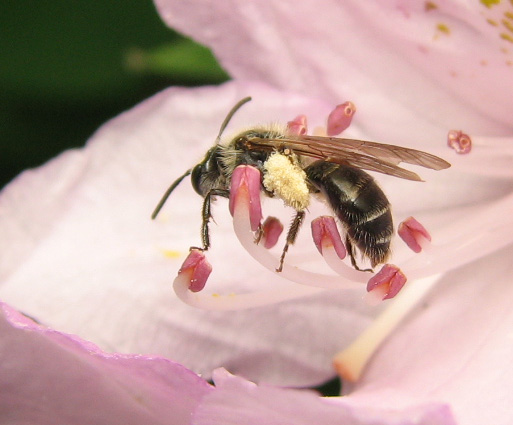
Shortly after, when azaleas bloom another set of specialists comes into service, the buzz pollinators. These are experts at shaking the pollen out of the flower stamens. One of these experts is the azalea Andrena bee. Its name needs no explanation.

So, what are honey bees doing in the meantime? They devote their time to the nectar and pollen of willows and maples. Thus, honey bees make use of these trees, but the trees themselves benefit from an abundance of native pollinators and don't need the extra help. Honey bees also gather pollen from hazelnuts. This is good for the bees but doesn't help the trees in the slightest because they are wind-pollinated.

Magnolia and mordellid beetles © Beatriz Moisset
Honey bees don't pollinate azaleas or rhododendrons. They also ignore dogwoods. As for magnolias and their close relatives, tulip trees, these plants are primarily pollinated by beetles and flies, all of them native. Honey bees are more inclined to visit generalist flowers, the ones receptive to a wide range of pollinators. Therefore, native pollinators are all that the flowers need.

Another problem with honey bees in natural areas is that they may contribute to the spread of non-native plants by pollinating them preferentially. They also may compete with native pollinators for floral resources.
Tricolored bumble bee © Beatriz Moisset
In summary, native plants and native pollinators are members of a complex community. They have adapted to each other and work well together. Honey bees, while important to agriculture, are not needed in natural areas. The only justification for keeping beehives at nature centers is to use them as a gate to the understanding and familiarization with insects and their usefulness. If the visitor leaves the nature center as ignorant of native pollinators as he was when he came in, then the center has failed to deliver the most valuable message of the bees.

It is imperative that naturalists and educators at nature centers with beehives devote time to informing the public about native pollinators and their significance to native plants. Posters with this information would also be helpful.
Augochlora pura © Beatriz Moisset

Tom Bain presents some good suggestions in his blog "GeoEcology. Earth and life through time..."

 "There is an essential piece missing from the typical presentation about pollination in many nature centers, that is the discussion of native pollinators and their essential continuing role in native and not so native ecosystems. Each presentation about honey bees should be accompanied by a hands-on activity to plant native plants that are partners to native pollinators, or the construction of simple solitary bee houses from dry bamboo canes or wood blocks. We would make progress if our children earned great take-home's like solitary bee bundles in place of coloring-in honey bee illustrations; and, planting native seeds to grow purple coneflower or other natives in place of marigolds, etc. A little effort and a subtle change in emphasis would shift attention to native pollinators."


© Beatriz Moisset. 2013