Translate

Showing posts with label native plants. Show all posts

Monday, May 16, 2016

Early Spring Pollinators and their Flowers

Bluebells and carpenter bee
© Beatriz Moisset

Many gardeners are developing a new concern for pollinators. They look for ways to help them. Aware that a perfectly manicured, pesticide-laden lawn is not good for pollinators they enthusiastically adopt a scattering of dandelions in the early spring.

This is certainly beneficial to pollinators. However some of the passionate claims that accompany this activity are somewhat exaggerated. It is not true that pollinators “need” dandelions. They would prefer other flowers if they had a chance.

Spicebush in bloom
© Beatriz Moisset
Spicebush and pollinator
© Beatriz Moisset
Before dandelions were introduced from Europe and before lawns became so rampant in our suburbs, early spring pollinators were faced with a smorgasbord of early spring flowers. Here is an incomplete list of the so-called spring ephemerals prevalent where I live, in the Mid-Atlantic region: spring beauty, trout lily, trillium, columbines, rue anemones, Dutchman's britches, bloodroot and bluebells. These and others can still be found in nature areas, although they have become extremely rare in gardens and parks. Perhaps even more important to early spring pollinators are a number of trees and shrubs, such as willows, maples (some, not all of them), serviceberry, sassafras, spicebush, redbud, and a little later, azaleas and dogwoods, just to name a few.

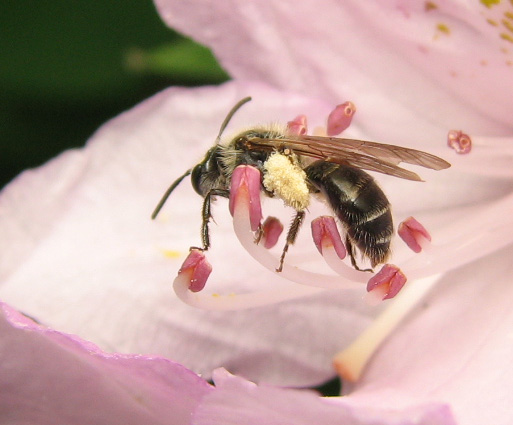
Spring beauty and spring beauty Andrena
© Beatriz Moisset
This assortment of flowering plants offers a rich and diverse diet to newly awakened queen bumble bees, early Andrena bees, and other bees and flies seeking pollen and nectar. Some pollinators are specialists on just one or a limited variety of flowers. The spring beauty Andrena, trout lily Andrena and several willow blossom devotees would look at dandelions in despair, not being able to make any use of them.

Trout lily, frequently visited
by the trout lily Andrena
© Beatriz Moisset
The biotic community described above not only nourishes early-riser pollinators but also provides food and habitat for local wildlife. For instance, the red maple serves as a host plant for more than 100 moth species, willows provide food for several hundred species of moths. In turn, these caterpillars nourish birds and other wildlife. By contrast a lawn with dandelions is an impoverished ecosystem with very limited ecological value, more similar to a refugee camp than to a healthy, lively community.

Azalea and its specialist
the azalea Andrena
© Beatriz Moisset
If the goal is to help pollinators we would reduce the size of the lawn and grow some of the plants mentioned above rather than simply allowing dandelions among the blades of grass.

Bloodroot and Red-necked False Blister Beetle
© Beatriz Moisset
Such a goal is hard to achieve for most gardeners and probably impossible or nearly impossible for many of them. So, reducing the use of pesticides and allowing dandelions, as well as a few other small lawn “weeds,” is a good decision. But anybody seriously committed to protecting, not just pollinators, but entire ecosystems would do well to take a look at other alternatives.


Dandelion visited by a cuckoo bee
© Beatriz Moisset
Dandelion and ants
© Beatriz Moisset

Sunday, February 7, 2016

Native species

Common milkweed, Asclepias syriaca (© B. Moisset)
Definitions of native plants abound. None is entirely satisfactory in all circumstances but each may serve a specific function. Some strive for scientific accuracy; others serve practical purposes. Moreover, in some instances the nativity of a plant may not matter to the native-plant gardener. None of us is about to give up growing tomatoes regardless of their non-native status.

The Federal Native Plant Conservation Committee proposes the following definition: “A native plant species is one that occurs naturally in a particular habitat, ecosystem, or region of the United States and its Territories or Possessions, without direct or indirect human actions.” Such definition may be useful for policy making.

The Lady Bird Johnson Wildflower Center of the University of Texas at Austin provides a sampling of definitions. Here are two:

“Native plants should be defined as those that have evolved and adapted to a specific location and have remained genetically unaltered by humans” (Wasowski. The American Gardener, 1998).

“All indigenous, terrestrial, and aquatic plant species that evolved naturally in an ecosystem” (US Forest Service).

Some may prefer other definitions from that list. In my opinion, the best ones are those that recognize the significance of co-evolution, habitats and ecosystems.

In North America, 1492 is commonly used as the cut-off date. It signals the arrival of Europeans on this continent and also the subsequent era of exploration of the entire planet. We may regard it as an arbitrary date; but it is one with practical usefulness as well as with historical significance. The numbers of introductions of non-native species and the distances to which they are transported started growing dramatically in 1492 and continue to grow at accelerated rates.

Humans have been introducing species to other lands from the beginning of agriculture (and unintentionally even earlier). Polynesians took pigs to Hawaii more than a thousand years ago. In recent times, Europeans introduced a new breed on the island. Is one breed more native than the other? Does it matter? We need to remember that the recently introduced breed is larger in size, more invasive, and more destructive of habitats. Habitat restoration may justify eradication of the European introduction. But removing the earlier breed, which is embedded in Hawaiian tradition and culture, would not be wise. This thorny issue will have to be decided by Hawaiians. I don’t envy them the task or the heated conflicts that this issue creates.

The Three Sisters of Native American agriculture –corn, squash and beans– are not truly native to North America. They were first cultivated in a region of Mexico and Central America several thousand years ago and carried farther north and east as well as into South America in prehistoric times. It is tempting to regard these crops as native plants, but they are not really so. Once again, the question is: Does it matter? Would those devoted to conservation and restoration want to eliminate these non-invasive, economically significant, long-established crops? Of course, not! This is not the purpose of restoration.

Further back, all species of organisms have been on the move at a certain point. To grow and multiply is a mandate as old as life itself. Those that successfully multiply need to expand their territories and invade new areas. The present geographic distribution of any given species tells us only a small part of the story. To understand the concept of native organisms, we need some knowledge of the origin, evolution, and dispersal of species and taxonomic groups.

We can use as an example that quintessential native plant, the common milkweed (Asclepias syriaca) and its relatives, the other milkweed members of the genus Asclepias.
Common milkweed flower and one of its visitors, a bumble bee (© B. Moisset)
The family of milkweeds originated in Africa many millions of years ago. Its members have been spreading out ever since. They occupied Asia, evolving into a number of new species along the way. They crossed the Bering Strait around 30 million years ago and, once again, they diversified into a number of related species. Nowadays, there are more than a hundred species of the genusAsclepias in North America. Some crossed the Isthmus of Panama and invaded South America, where they evolved into a handful of species. I find it very interesting that many millions of years later a mammalian species would originate in Africa and follow a similar itinerary all the way to the tip of Patagonia in South America. I am talking about us, Homo sapiens.
Geographic distribution of Asclepias syriacaUSDA map
USDA maps illustrating the geographic distribution of species ofAsclepiasSee the complete page
The USDA maps show the distribution of the common milkweed, Asclepias syriaca, and of other members of the genus. The common milkweed is found in all the Eastern United States and Canada and also in parts of the West. Other milkweeds occupy more limited territories, some overlapping each other. We can be certain that their geographic ranges have not remained constant in the thousands of years of their existences. They responded to climatic changes that caused glaciers to expand and retreat by migrating north or south and by contracting and expanding their territories accordingly. Still, we regard them as native to the areas where they are naturally present.

Adult monarch on common milkweed (© B. Moisset)

Milkweeds didn’t come alone. They are part of ecological communities that include other species, some tightly, other loosely, linked. Milkweed butterflies, having tied their destinies to those of milkweeds, followed their host plants. The genusDanaus originated in Africa and spread out along with milkweeds covering similar territories. These were the ancestors of the monarch butterfly (Danaus plexippus) and its relatives.
Longhorn milkweed beetles (© B. Moisset)
In fact, the southern monarch (Danaus erippus), a resident of southern South America, is so similar to the North American monarch that both were considered members of the same species until recently. Curiously, this southern monarch, like its northern sister, is migratory. Even more curiously, it migrates south to a colder climate, when winter comes. This is the kind of natural history mystery that keeps me awake at night. I hope that somebody uncovers the secrets of the southern monarch and lets me know.Monarch butterflies are not the only insects that take advantage of milkweeds. A whole menagerie has evolved to feed on these plants. There are milkweed longhorn beetles, large and small milkweed bugs, milkweed weevils, and milkweed tussock moths, just to name the most familiar ones. All of them are adapted to the strong milkweed toxins. These poisons remain in their tissues and give them some protection against predators, which find them inedible.

Lady beetle larva, Coleomegilla (© B. Moisset)
However, despite the protection that the milkweed toxins provide to its feeders, some predators and parasites are adapted to this inconvenience. Several species of birds and mice feed on monarchs, both in this country and in Mexico, where they spend the winter. A number of predatory and parasitic insects also depend on monarch butterflies for nourishment. Thus the milkweeds and their dependents and the other components of the food chain are all linked together. They have been co-evolving for millions of years and are functional parts of their ecosystems.

Silver-spotted skipper (© B. Moisset)
These relationships matter when we talk about native plants. A non-native organism, one newly arrived into an ecosystem, lacks this kind of co-evolved interactions with the other members of the community. It is not a functional component of the ecosystem. Eventually, new interactions will develop given enough time. This may take tens of thousands or millions of years. This is why the best definitions of native plants involve the words “co-evolution,” “habitat,” “community,” or “ecosystem.”

In some instances, it is hard to tell what is native. In certain cases, it may not be important or practical to consider the nativity of a plant, as in the example of the crops grown by Native Americans. That which really matters is the long established and complex relationships present in ecosystems. A native plant is one that is ecologically linked to other components of the ecosystem where it is found.

Some important concepts lack a perfect definition. We need to name them, nonetheless. Biologists would be lost if they couldn’t use the concept of “species” just because no definition fits all the circumstances. This word is not only important but absolutely necessary. One may need to use different definitions of “species” depending on the discipline; but that is no reason to give up the word. The concept of “native” organisms is equally necessary. It is here to stay, regardless of the difficulties that may arise at times.
Robins are among the birds that sometimes eat monarchs (© B. Moisset)
Originally published by Native Plants and Wildlife Gardens

© 2012, Beatriz Moisset. All rights reserved. This article is the property of Native Plants and Wildlife Gardens.

List of articles
Beginners Guide to Pollinators and Other Flower Visitors

Sunday, June 28, 2015

What is native? What is not? When does it matter?

Common milkweed, Asclepias syriaca (© B. Moisset)
Definitions of native plants abound. None is entirely satisfactory in all circumstances but each may serve a specific function. Some strive for scientific accuracy; others serve practical purposes. Moreover, in some instances the nativity of a plant may not matter to the native-plant gardener. None of us is about to give up growing tomatoes regardless of their non-native status.

Some important concepts lack a perfect definition. We need to name them, nonetheless. Biologists would be lost if they couldn’t use the concept of “species” just because no definition fits all the circumstances. This word is not only important but absolutely necessary. One may need to use different definitions of “species” depending on the discipline; but that is no reason to give up the word. The concept of “native” organisms is equally necessary. It is here to stay, regardless of the difficulties that may arise at times.

Read the whole article in Native Plants and Wildlife Gardens.
or Archive Native Plants and wildlife Gardens

Thursday, September 18, 2014

Sneezeweed or Helenium


Halictid male bee on Helenium. © Beatriz Moisset
It is September, the days are getting shorter, the weather cooler. Plants put up a display that rivals or even surpasses that of spring. Asters, goldenrods, coneflowers and a number of other similar flowers create a golden explosion in gardens and meadows. Pollinators seem busier than ever, taking advantage of this bounty. Insect flower visitors love yellow and flowers seem to know it. They dress up in colors that attract their favorite visitors in the hope that they carry pollen to other flowers of the same kind. Pollinators, in turn, know that abundant resources await them in the bright yellow flowers.

Fig. 1. Three Helenium blossoms of different ages. © Beatriz Moisset
Let us look at one of these flowers in closer detail. Helenium, also called sneezeweed, has the same structure as sunflowers and asters, a crown of petals and a center made of little knobby structures called florets. Each one of those knobs is an entire flower which produces pollen and seeds. Each one needs to be pollinated in order to produce a seed. The dead heads you see later in the fall are little packages of these nutritious mature seeds that bring joy to passing hungry birds.

Fig. 2. Several Helenium or sneezeweed flowers. © Beatriz Moisset
The florets do not mature all at once. They proceed in an organized fashion from the outer ring to the center, row by row; they open and expose the pollen-carrying anthers and the pistils ready to receive pollen. They also fill up with nectar. Only one row or two at a time are ready to welcome visitors and to be pollinated. Bees know that. Even syrphid flies know that. You can see them moving from floret to floret until they complete the circle. Then they fly to the next blossom. They know enough not to waste time on the unopened flowers or the ones past their prime.

Bumble bee collecting pollen and nectar from open florets. © Beatriz Moisset
 Take a look at figure 1. The sneezeweed blossom near the center is quite fresh; most florets are still closed; only one is almost ready for pollination. The one in the upper right is halfway through; there are still some rows of unopened florets to go. The one below it is approaching old age, almost all done. Now, you can look at Helenium flowers and determine their approximate age just by looking at them. What do you think about the flowers in figure 2?

Another bumble bee. © Beatriz Moisset
 Smart pollinators, not only know where the food is in each flower, but also know that they will continue to find supplies in the following days. Bumble bees are known to faithfully come back to their favorite flower patches.

Sunflowers and asters do the same. See the following examples:

Agapostemon female on sunflower. © Beatriz Moisset


Halictid bee on coneflower. © Beatriz Moisset


Syrphid fly, Toxomerus on daisy. © Beatriz Moisset
 
Skipper on sunflower. © Beatriz Moisset


List of articles
Beginners Guide to Pollinators and Other Flower Visitors

© Beatriz Moisset. 2014


Saturday, October 5, 2013

When did "Common Milkweed" Become Common?

Monarch on common milkweed. © Beatriz Moisset. 2010

The prairies of this continent used to be rich in biodiversity before they were plowed under and turned into cropland. We can only guess at the structure of those lost plant communities by studying the remaining plots of prairie. A couple dozen species of milkweed (Asclepias) prospered in the Midwest two centuries ago, each adapted to its own habitat. Certain species preferred high moisture, others, drier spots. Some showed a preference for coarse, loose, damp, or undisturbed soils; still others did well on almost any soil type. Some needed more sunlight than others. A few survived drought or fire better than others.

Among this variety of habitat preferences, common milkweed, Asclepias syriaca, a "weedy" or pioneer species, does best in disturbed areas, patches that, for a variety of reasons, have lost their established vegetation. In a few years, it is displaced by other species when the ecological succession continues. Two hundred years ago, disturbed spots must have been rather uncommon. Everything changed when the prairie became farmland and was annually plowed. Many species of these plants lost ground under the new treatment. However, plowing created ideal conditions for the common milkweed. It can grow between rows of plantings and along edges, and its deep rhizomes, underground stems, allow it to survive year after year despite plowing. Is this when common milkweed earned its name?

For many years, farming practices in the Midwest continued to disrupt the land creating the conditions that this plant prefers. Farmers dislike this plant for its tenacity. It is said that farmers rejoice at the sight of big fat yellow and black caterpillars devouring the cursed weed. By now, you probably guessed that those caterpillars are monarchs.

USDA map of corn production

Monarch butterflies feed on most types of Asclepias, but Asclepias syriaca is by far their main food source. Perhaps, when the prairie became our breadbasket, it also became the monarch's breadbasket, who took advantage of the spreading weed.

In the meantime, all along the Eastern United States, forests were being cut down. A tree-covered area is not the right habitat for any types of milkweeds. When forests were cleared, the conditions favored by common milkweed emerged. Populations of monarchs must have grown along with the expansion of this plant.

If all this is true, and much of it may be just speculation, then these butterflies must have benefited from these man-made changes. We must ask ourselves: what were the monarch's populations like before the expansion of common milkweed numbers? Were they as abundant before the early 1800s as in recent times? What were the population sizes in their overwintering sites in Mexico? We became aware of the monarch butterfly migration in the past one hundred years. The whole story of their incredible trip to Mexico became known only in recent years. Curiously, no references to monarchs in Mexico can be found until 1890. By then, the transformation of the Midwest with its expansion of common milkweed was well underway. Were their numbers in Mexico so low before this time to escape notice?

Present day discussions about monarchs and their preferred food plant, common milkweed, seem to accept the numbers reported around the 1950s as the norm. Those were the highest numbers ever recorded, and it is assumed that these had remained the same for a long time, perhaps from the days when glaciers receded, tens of thousands of years ago. However, we must consider the possibility that milkweeds and monarchs were never as abundant as in the twentieth century; that this is largely a man-made phenomenon. The numbers of both, plant and butterfly have been going down steadily in recent years. Is the new normal similar to the old normal of hundreds of years ago?

Monarch caterpillar on common milkweed. © Beatriz Moisset. 2010


List of Articles

Beginners Guide to Pollinators and Other Flower Visitor

© Beatriz Moisset. 2013

Friday, June 21, 2013

Native Bees, Honey Bees and Natural Areas

Spring beauty bee © Beatriz Moisset

It is common practice for nature centers to have a beehive. Often, a glass wall allows observation of the colony's busy life, seldom failing to catch the eye of visitors. This serves an educational purpose by providing a great opportunity for a behind-the-scenes peek at the private lives of honey bees. Thus, visitors learn about these useful insects and their role as crop pollinators.

Honey bee © Beatriz Moisset
Sometimes I wonder if we are delivering the right message. The purpose of nature centers is to protect natural wildlife and to promote conservation of natural resources. This is clearly stated in many of their mission statements. Honey bees and chickens are domestic animals. They are both important to agriculture. However, we don't keep chickens at the bird feeders to teach about birds. Do we need honey bees to teach about insects?

Nowadays, agriculture relies heavily on honey bees; however, we must bear in mind that honey bees were introduced to this continent by Europeans a few hundred years ago. Until then, all pollination was accomplished by native pollinators, more than 4,000 species of bees and many other insects, such as flies, moths, wasps and even beetles, as well as some birds and bats.

Jack-in-the-pulpit © Beatriz Moisset
Fungus gnats © Beatriz Moisset

Native plants didn't need honey bees then, and they don't need them now. A few examples should suffice. In early spring a number of delicate little flowers carpet the forest floor. They are in a rush to take advantage of the sunlight during the absence of foliage and don’t last long. Thus, they are called "spring ephemerals." None of them is visited by honey bees. In fact, many resort to highly specialized pollinators which have been around for as long as the plants themselves. Skunk cabbage and Jack-in-the-pulpit are pollinated by flies. Spring beauties and trout lilies are visited by an assortment of bees and bumble bees; but get help, in particular, from their own specialized pollinators, the so called spring beauty bee and the trout lily bee respectively.

Azalea bee © Beatriz Moisset
Shortly after, when azaleas bloom another set of specialists comes into service, the buzz pollinators. These are experts at shaking the pollen out of the flower stamens. One of these experts is the azalea Andrena bee. Its name needs no explanation.

So, what are honey bees doing in the meantime? They devote their time to the nectar and pollen of willows and maples. Thus, honey bees make use of these trees, but the trees themselves benefit from an abundance of native pollinators and don't need the extra help. Honey bees also gather pollen from hazelnuts. This is good for the bees but doesn't help the trees in the slightest because they are wind-pollinated.

Magnolia and mordellid beetles © Beatriz Moisset
Honey bees don't pollinate azaleas or rhododendrons. They also ignore dogwoods. As for magnolias and their close relatives, tulip trees, these plants are primarily pollinated by beetles and flies, all of them native. Honey bees are more inclined to visit generalist flowers, the ones receptive to a wide range of pollinators. Therefore, native pollinators are all that the flowers need.

Another problem with honey bees in natural areas is that they may contribute to the spread of non-native plants by pollinating them preferentially. They also may compete with native pollinators for floral resources.
Tricolored bumble bee © Beatriz Moisset
In summary, native plants and native pollinators are members of a complex community. They have adapted to each other and work well together. Honey bees, while important to agriculture, are not needed in natural areas. The only justification for keeping beehives at nature centers is to use them as a gate to the understanding and familiarization with insects and their usefulness. If the visitor leaves the nature center as ignorant of native pollinators as he was when he came in, then the center has failed to deliver the most valuable message of the bees.

It is imperative that naturalists and educators at nature centers with beehives devote time to informing the public about native pollinators and their significance to native plants. Posters with this information would also be helpful.
Augochlora pura © Beatriz Moisset

Tom Bain presents some good suggestions in his blog "GeoEcology. Earth and life through time..."

 "There is an essential piece missing from the typical presentation about pollination in many nature centers, that is the discussion of native pollinators and their essential continuing role in native and not so native ecosystems. Each presentation about honey bees should be accompanied by a hands-on activity to plant native plants that are partners to native pollinators, or the construction of simple solitary bee houses from dry bamboo canes or wood blocks. We would make progress if our children earned great take-home's like solitary bee bundles in place of coloring-in honey bee illustrations; and, planting native seeds to grow purple coneflower or other natives in place of marigolds, etc. A little effort and a subtle change in emphasis would shift attention to native pollinators."


© Beatriz Moisset. 2013