Translate

Showing posts with label Andrena. Show all posts

Monday, May 16, 2016

Early Spring Pollinators and their Flowers

Bluebells and carpenter bee
© Beatriz Moisset

Many gardeners are developing a new concern for pollinators. They look for ways to help them. Aware that a perfectly manicured, pesticide-laden lawn is not good for pollinators they enthusiastically adopt a scattering of dandelions in the early spring.

This is certainly beneficial to pollinators. However some of the passionate claims that accompany this activity are somewhat exaggerated. It is not true that pollinators “need” dandelions. They would prefer other flowers if they had a chance.

Spicebush in bloom
© Beatriz Moisset
Spicebush and pollinator
© Beatriz Moisset
Before dandelions were introduced from Europe and before lawns became so rampant in our suburbs, early spring pollinators were faced with a smorgasbord of early spring flowers. Here is an incomplete list of the so-called spring ephemerals prevalent where I live, in the Mid-Atlantic region: spring beauty, trout lily, trillium, columbines, rue anemones, Dutchman's britches, bloodroot and bluebells. These and others can still be found in nature areas, although they have become extremely rare in gardens and parks. Perhaps even more important to early spring pollinators are a number of trees and shrubs, such as willows, maples (some, not all of them), serviceberry, sassafras, spicebush, redbud, and a little later, azaleas and dogwoods, just to name a few.

Spring beauty and spring beauty Andrena
© Beatriz Moisset
This assortment of flowering plants offers a rich and diverse diet to newly awakened queen bumble bees, early Andrena bees, and other bees and flies seeking pollen and nectar. Some pollinators are specialists on just one or a limited variety of flowers. The spring beauty Andrena, trout lily Andrena and several willow blossom devotees would look at dandelions in despair, not being able to make any use of them.

Trout lily, frequently visited
by the trout lily Andrena
© Beatriz Moisset
The biotic community described above not only nourishes early-riser pollinators but also provides food and habitat for local wildlife. For instance, the red maple serves as a host plant for more than 100 moth species, willows provide food for several hundred species of moths. In turn, these caterpillars nourish birds and other wildlife. By contrast a lawn with dandelions is an impoverished ecosystem with very limited ecological value, more similar to a refugee camp than to a healthy, lively community.

Azalea and its specialist
the azalea Andrena
© Beatriz Moisset
If the goal is to help pollinators we would reduce the size of the lawn and grow some of the plants mentioned above rather than simply allowing dandelions among the blades of grass.

Bloodroot and Red-necked False Blister Beetle
© Beatriz Moisset
Such a goal is hard to achieve for most gardeners and probably impossible or nearly impossible for many of them. So, reducing the use of pesticides and allowing dandelions, as well as a few other small lawn “weeds,” is a good decision. But anybody seriously committed to protecting, not just pollinators, but entire ecosystems would do well to take a look at other alternatives.


Dandelion visited by a cuckoo bee
© Beatriz Moisset
Dandelion and ants
© Beatriz Moisset

Friday, June 21, 2013

Native Bees, Honey Bees and Natural Areas

Spring beauty bee © Beatriz Moisset

It is common practice for nature centers to have a beehive. Often, a glass wall allows observation of the colony's busy life, seldom failing to catch the eye of visitors. This serves an educational purpose by providing a great opportunity for a behind-the-scenes peek at the private lives of honey bees. Thus, visitors learn about these useful insects and their role as crop pollinators.

Honey bee © Beatriz Moisset
Sometimes I wonder if we are delivering the right message. The purpose of nature centers is to protect natural wildlife and to promote conservation of natural resources. This is clearly stated in many of their mission statements. Honey bees and chickens are domestic animals. They are both important to agriculture. However, we don't keep chickens at the bird feeders to teach about birds. Do we need honey bees to teach about insects?

Nowadays, agriculture relies heavily on honey bees; however, we must bear in mind that honey bees were introduced to this continent by Europeans a few hundred years ago. Until then, all pollination was accomplished by native pollinators, more than 4,000 species of bees and many other insects, such as flies, moths, wasps and even beetles, as well as some birds and bats.

Jack-in-the-pulpit © Beatriz Moisset
Fungus gnats © Beatriz Moisset

Native plants didn't need honey bees then, and they don't need them now. A few examples should suffice. In early spring a number of delicate little flowers carpet the forest floor. They are in a rush to take advantage of the sunlight during the absence of foliage and don’t last long. Thus, they are called "spring ephemerals." None of them is visited by honey bees. In fact, many resort to highly specialized pollinators which have been around for as long as the plants themselves. Skunk cabbage and Jack-in-the-pulpit are pollinated by flies. Spring beauties and trout lilies are visited by an assortment of bees and bumble bees; but get help, in particular, from their own specialized pollinators, the so called spring beauty bee and the trout lily bee respectively.

Azalea bee © Beatriz Moisset
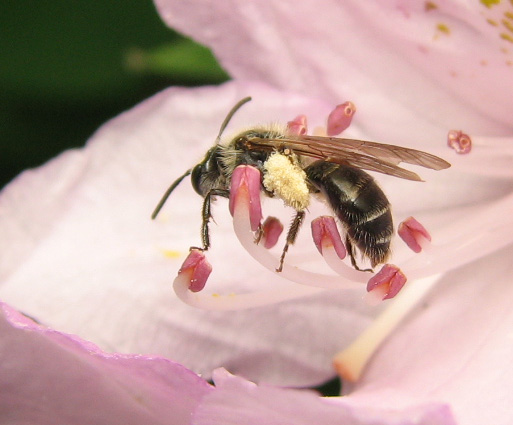
Shortly after, when azaleas bloom another set of specialists comes into service, the buzz pollinators. These are experts at shaking the pollen out of the flower stamens. One of these experts is the azalea Andrena bee. Its name needs no explanation.

So, what are honey bees doing in the meantime? They devote their time to the nectar and pollen of willows and maples. Thus, honey bees make use of these trees, but the trees themselves benefit from an abundance of native pollinators and don't need the extra help. Honey bees also gather pollen from hazelnuts. This is good for the bees but doesn't help the trees in the slightest because they are wind-pollinated.

Magnolia and mordellid beetles © Beatriz Moisset
Honey bees don't pollinate azaleas or rhododendrons. They also ignore dogwoods. As for magnolias and their close relatives, tulip trees, these plants are primarily pollinated by beetles and flies, all of them native. Honey bees are more inclined to visit generalist flowers, the ones receptive to a wide range of pollinators. Therefore, native pollinators are all that the flowers need.

Another problem with honey bees in natural areas is that they may contribute to the spread of non-native plants by pollinating them preferentially. They also may compete with native pollinators for floral resources.
Tricolored bumble bee © Beatriz Moisset
In summary, native plants and native pollinators are members of a complex community. They have adapted to each other and work well together. Honey bees, while important to agriculture, are not needed in natural areas. The only justification for keeping beehives at nature centers is to use them as a gate to the understanding and familiarization with insects and their usefulness. If the visitor leaves the nature center as ignorant of native pollinators as he was when he came in, then the center has failed to deliver the most valuable message of the bees.

It is imperative that naturalists and educators at nature centers with beehives devote time to informing the public about native pollinators and their significance to native plants. Posters with this information would also be helpful.
Augochlora pura © Beatriz Moisset

Tom Bain presents some good suggestions in his blog "GeoEcology. Earth and life through time..."

 "There is an essential piece missing from the typical presentation about pollination in many nature centers, that is the discussion of native pollinators and their essential continuing role in native and not so native ecosystems. Each presentation about honey bees should be accompanied by a hands-on activity to plant native plants that are partners to native pollinators, or the construction of simple solitary bee houses from dry bamboo canes or wood blocks. We would make progress if our children earned great take-home's like solitary bee bundles in place of coloring-in honey bee illustrations; and, planting native seeds to grow purple coneflower or other natives in place of marigolds, etc. A little effort and a subtle change in emphasis would shift attention to native pollinators."


© Beatriz Moisset. 2013

Friday, May 24, 2013

One Bite out of Three


Megachilid or mason bee, often used to pollinate fruit trees.
© Beatriz Moisset

We frequently hear that "one bite out of three comes to you courtesy of pollinators." Other times we hear it expressed as "one bite out of three comes to you courtesy of bees," implying that the bees in question are honey bees. Where did these statements originate? How well documented are they? It all sounds plausible but I hesitate to cite numbers without certainty when I give presentations about pollinators.

Fortunately a group at the University of California at Berkeley decided to get to the bottom of it. I am happy to tell you that they found the first statement to be fundamentally accurate.

Claire Kremen, one of the coauthors of the study and member of the Committee on Status of Pollinators, summarizes the results of their 2006 study as follows: "Out of the 115 crops studied, 87 depend to some degree upon animal pollination, accounting for one-third of crop production globally."

Now, I can relax and go on telling my audiences that pollinators are responsible for one third of our food. I can also face the second claim, "one bite out of three comes to you courtesy of bees." This claim originates from the confusion between pollinators, bees in general and honey bees, and it is not accurate. Some information is in order.

Augochlora pura bees.
© Beatriz Moisset
Honey bees are the most important pollinators of agricultural crops. They excel at pollinating a number of fruit trees such as apples, pears, peaches and almonds. But they are not alone in this task. We owe a lot to all the other carriers of pollen, 20,000 species of bees (4,000 in North America alone) and an assortment of wasps, moths, flies and even bats.
Anthophorini bee. It pollinates several crops.
© Beatriz Moisset
Let us look at crops pollinated mostly or entirely by non-honey-bee pollinators. Alfalfa is the most important one that comes to mind. No, we don't eat alfalfa but cows, sheep, goats and even chickens do. Without alfalfa these animals would be severely malnourished; they may not even survive. Most alfalfa growers use the services of bumble bees, alkali bees and alfalfa bees or a combination of the above plus a few other bees. These insects are well adapted to the structure of alfalfa flowers and handle them efficiently. Honey bees, on the other hand, are not fond of these blossoms and do a poor job. It may take several honey bees to do the job of one alfalfa bee; but they make up in numbers what they lack in finesse. This is why they are used in large alfalfa fields where there is no habitat left for other bees, particularly in California.

When New Zealand ranchers started raising cattle, they also needed to grow clover for cattle feed. They had to purchase seed from abroad every year because the plants failed to set seed for lack of pollinators. European bumble bees were imported to do the job, and in fact they promptly took care of the problem. Notice that it was bumble bees rather than honey bees which were counted for this mission.
Bumble bee buzz-pollinating azalea. © Beatriz Moisset
See video
The flowers of tomatoes, eggplants, peppers and other members of the potato family require special handling by the pollinator, a process called buzz pollination. Bumble bees and other native bees do this efficiently. Honey bees cannot, do not perform this maneuver. For a brief explanation of buzz pollination see: Buzz Pollination by Sue Rosenthal.

Blueberries and cranberries are mostly buzz pollinated. Unfortunately, large fields of these crops provide no habitat for the native bees and bumble bees which are most adept at this task. Under these circumstances, honey bees are used as pollinators despite their poor performance.
Yucca moth, a highly specialized pollinator. © Beatriz Moisset

Figs are pollinated by fig wasps, yucca by yucca moths, and mangoes by bats. A few other specialty crops use the services of specialized insects. Several species of flies are used to pollinate some crops such as onions and cabbage. Honey bees, or even other bees are not involved here, either.

In summary, we must remember to give credit to all pollinators. Let us thank them all. My favorite one is not a honey bee, not even a bee. It is the little fly, or midge, that pollinates the cacao flowers. What would the world be without chocolate?

Importance of pollinators in changing landscapes for world crops

List of Articles 
Also, see Bees and Vitamins. The importance of pollinators goes beyond the "one bite out of three" to our basic nutrition needs.
Update to pollinators and vitamins: Contribution of Nutrients by Pollinators
One Bite out of Three and Wildlife
One Bite out of Three before Columbus

Beginners Guide to Pollinators and Other Flower Visitor

© Beatriz Moisset. 2013