Translate

Showing posts with label bumblebee. Show all posts

Monday, February 20, 2017

Spurs: Hard to Get Nectar

Violet.
© Beatriz Moisset
 Many flowers are very particular about their clientele. They have developed ways to make themselves attractive to certain flower visitors while discouraging others. They do so by adopting a certain shape. The spurs of many flowers serve this purpose. A petal or a sepal develops an elongated hollow spike. This is what botanists call a spur.

Violet (Viola mirabilis). Note the spur
Wikicommons. © Antti Bilund

Violets have a spur. Nectar is collected at its bottom. A pollinator needs a tongue long enough to reach the hidden nectar waiting in this special vessel. The rest of the flower is so designed that the insect gets covered with pollen while performing this task. If it is carrying pollen from a previous flower visit, it is likely to deposit it on the stigma. Only long tongued insects can take advantage of this flower and they need to develop an efficient way to approach this specially shaped blossom. After a few times they get better and better and proceed faster. The most common pollinators of violets are small, solitary bees.

Bumble bee visiting a jewelweed blossom
© Beatriz Moisset
Jewelweed (Impatiens) also possess a spur. The flower itself is a small chamber just a little larger than a bumble bee. The petals form a curtain that slightly blocks the entrance to this chamber. Bumble bees are pros at collecting nectar from these flowers. Their plump bodies fit inside the chamber like a finger in a glove and their long and flexible tongues are suited to the curved spur.

Columbine.
© Beatriz Moisset

Columbines have not one but five spurs. Each petal is shaped like a long hollow horn ending on a knob. This is where the nectar gathers. Long tongued insects and hummingbirds pollinate these flowers. In most species, the flower nods or points downward, and the spurs point to the sky. This arrangement seems to be agreeable to their most common pollinators, hummingbirds.

Columbine.
© Beatriz Moisset
By contrast, the flowers of the alpine columbine remain erect, don't nod. They are also creamy white, a color favored by moths. And thus, they are preferably pollinated by large moths, the so called hawkmoths. A few other species of columbines, including the Colorado blue columbine, also face upwards and are also pollinated by moths.

Columbine and carpenter bee
stealing nectar
© Beatriz Moisset
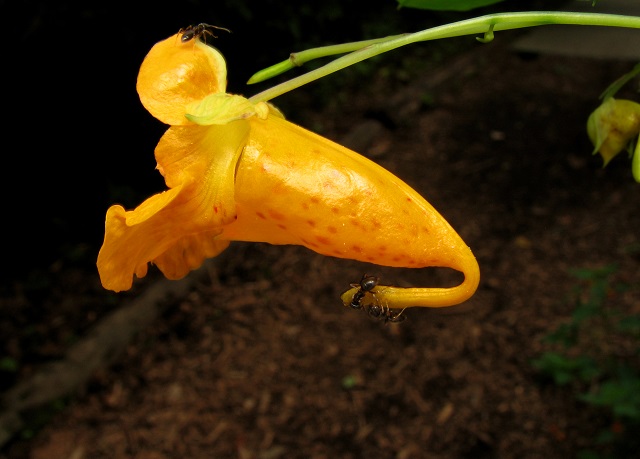
Jewelweed and ants
stealing nectar
© Beatriz Moisset
This specialization has advantages but it also has some disadvantages. Not all flower visitors behave like honest pollinators. These difficult flowers are an invitation to cheating. Some visitors learn to take a shortcut, especially if their tongues aren't long enough to reach the bottom of the spur. They approach the flower from the side. Perhaps, they can smell the sweets through the walls of the spur. A quick bite or a stab through the delicate petal may be all it takes to reach the hidden food. Carpenter bees, bumble bees and even ants have been seen performing this robbery.


List of articles
Beginners Guide to Pollinators and Other Flower Visitors

© Beatriz Moisset. 2017

Friday, August 16, 2013

Bumble Bees and Odor Pollution

Bumble bee and lawnmower


This morning they were mowing the lawn in my condominium. Wanting to leave the nerve racking noise behind, I headed for my favorite wildflower garden at Pennypack Ecological Restoration Trust. Instead of escaping the roar, I was treated to another dose of lawn mowing there. The weather was perfect for observing pollinators, so I stayed despite my discomfort.

Bumble bees were going about their business, gathering supplies for their brood, apparently unconcerned by the cacophony. I would like to think that they are equally immune to the fumes of gasoline, but suspect that it isn't so. When the noise stopped, I wondered: how long do the fumes remain? How far do they reach? How do they affect pollinators?

Pollinators need odor cues to find their food. Flowers emit scents to entice their favorite pollinators. These aromas are carried by the breeze, creating trails that bumble bees pick up in their wanderings. Studies show that it takes them longer to find these trails when gasoline fumes are present. It may not be apparent to observers, but lawn mowing impairs the productivity of bumble bees and other pollen seekers. Needless to say, car traffic has the same effect.
Now, you can hear the sounds of nature


References

Friday, June 21, 2013

Native Bees, Honey Bees and Natural Areas

Spring beauty bee © Beatriz Moisset

It is common practice for nature centers to have a beehive. Often, a glass wall allows observation of the colony's busy life, seldom failing to catch the eye of visitors. This serves an educational purpose by providing a great opportunity for a behind-the-scenes peek at the private lives of honey bees. Thus, visitors learn about these useful insects and their role as crop pollinators.

Honey bee © Beatriz Moisset
Sometimes I wonder if we are delivering the right message. The purpose of nature centers is to protect natural wildlife and to promote conservation of natural resources. This is clearly stated in many of their mission statements. Honey bees and chickens are domestic animals. They are both important to agriculture. However, we don't keep chickens at the bird feeders to teach about birds. Do we need honey bees to teach about insects?

Nowadays, agriculture relies heavily on honey bees; however, we must bear in mind that honey bees were introduced to this continent by Europeans a few hundred years ago. Until then, all pollination was accomplished by native pollinators, more than 4,000 species of bees and many other insects, such as flies, moths, wasps and even beetles, as well as some birds and bats.

Jack-in-the-pulpit © Beatriz Moisset
Fungus gnats © Beatriz Moisset

Native plants didn't need honey bees then, and they don't need them now. A few examples should suffice. In early spring a number of delicate little flowers carpet the forest floor. They are in a rush to take advantage of the sunlight during the absence of foliage and don’t last long. Thus, they are called "spring ephemerals." None of them is visited by honey bees. In fact, many resort to highly specialized pollinators which have been around for as long as the plants themselves. Skunk cabbage and Jack-in-the-pulpit are pollinated by flies. Spring beauties and trout lilies are visited by an assortment of bees and bumble bees; but get help, in particular, from their own specialized pollinators, the so called spring beauty bee and the trout lily bee respectively.

Azalea bee © Beatriz Moisset
Shortly after, when azaleas bloom another set of specialists comes into service, the buzz pollinators. These are experts at shaking the pollen out of the flower stamens. One of these experts is the azalea Andrena bee. Its name needs no explanation.

So, what are honey bees doing in the meantime? They devote their time to the nectar and pollen of willows and maples. Thus, honey bees make use of these trees, but the trees themselves benefit from an abundance of native pollinators and don't need the extra help. Honey bees also gather pollen from hazelnuts. This is good for the bees but doesn't help the trees in the slightest because they are wind-pollinated.

Magnolia and mordellid beetles © Beatriz Moisset
Honey bees don't pollinate azaleas or rhododendrons. They also ignore dogwoods. As for magnolias and their close relatives, tulip trees, these plants are primarily pollinated by beetles and flies, all of them native. Honey bees are more inclined to visit generalist flowers, the ones receptive to a wide range of pollinators. Therefore, native pollinators are all that the flowers need.

Another problem with honey bees in natural areas is that they may contribute to the spread of non-native plants by pollinating them preferentially. They also may compete with native pollinators for floral resources.
Tricolored bumble bee © Beatriz Moisset
In summary, native plants and native pollinators are members of a complex community. They have adapted to each other and work well together. Honey bees, while important to agriculture, are not needed in natural areas. The only justification for keeping beehives at nature centers is to use them as a gate to the understanding and familiarization with insects and their usefulness. If the visitor leaves the nature center as ignorant of native pollinators as he was when he came in, then the center has failed to deliver the most valuable message of the bees.

It is imperative that naturalists and educators at nature centers with beehives devote time to informing the public about native pollinators and their significance to native plants. Posters with this information would also be helpful.
Augochlora pura © Beatriz Moisset

Tom Bain presents some good suggestions in his blog "GeoEcology. Earth and life through time..."

 "There is an essential piece missing from the typical presentation about pollination in many nature centers, that is the discussion of native pollinators and their essential continuing role in native and not so native ecosystems. Each presentation about honey bees should be accompanied by a hands-on activity to plant native plants that are partners to native pollinators, or the construction of simple solitary bee houses from dry bamboo canes or wood blocks. We would make progress if our children earned great take-home's like solitary bee bundles in place of coloring-in honey bee illustrations; and, planting native seeds to grow purple coneflower or other natives in place of marigolds, etc. A little effort and a subtle change in emphasis would shift attention to native pollinators."


© Beatriz Moisset. 2013

Sunday, June 16, 2013

One Bite out of Three and Wildlife


So, we all agree that we owe one third of our food to pollinators. Now let us stop thinking about us; instead let us devote a few minutes to our companions on planet Earth. Does wildlife need pollinators as much as we do? It seems that nobody has looked at this matter systematically, thus, it is not an easy question to answer. Yet, we can try.

I will try to look at the diets of some feathered and furred creatures, mammals and birds and ignore for now the scaly or slimy sorts, amphibians, fish and reptiles. I will merely list the foods that need the services of pollinators, rather than attempting to estimate percentages for lack of information in the matter. What we are trying to see is whether wildlife requires the services of pollinators. Also, I will not bore you with long lists of animals and their diets, simply limit myself to some better known examples.


Birds that come to our backyard feeders are easy to observe. They show a preference for sunflower, thistle and peanuts. Summer and winter, many birds depend on berries, from blueberries to raspberries to crabapples to holly. Of course, not all their food is insect pollinated like the ones mentioned above. Many birds feed on insects and or grass seed. You can learn more about the role of pollinators on the diets of some of the most beloved songbirds such as wood thrushes and blue birds at the North American Pollinator Protection Campaign fact sheet.


Another common wildlife of our forests and backyards is the squirrel. The eating habits of squirrels are similar to ours as a look at the way they dig through our leftovers proves. When there is no human garbage around, they go through a variety of berries, seeds and tender leaves. It would be safe to conclude that they are as indebted to pollinators as we are. The same could be said of raccoons.

One animal that symbolizes wildlife more than most is the bear. Let as take a quick look at what a bear eats through the year. When it comes out of hibernation, there isn't much plant life around, except for skunk cabbage, and skunk cabbage becomes its breakfast, lunch and dinner with some Jack-in-the-pulpit as a side dish. A bear must have a strong stomach because these plants have tiny salt crystals that would make most other animals, including us, very, very sick. I mentioned in previous posts that skunk cabbage and Jack-in-the-pulpit are both pollinated by small flies, which are the only pollinators flying around so early in the season.


Other foods become available later on. A bear will add some vegetables to a wide range of other things. When fall comes and berries ripen, it is the time to eat berries. In areas where blueberries are abundant, a bear is likely to spend long hours in blueberry fields, gorging itself. Do I need to repeat that most berries are pollinated by insects?


The many herbivores, deer, bison, skunk, rabbit, may eat mostly wind-pollinated grasses; but they also need other nutrients that can only be obtained from flowering plants, from clovers to asters.

Finally, if you are wondering, even meat-eaters benefit from pollinators, since much of their food, the herbivores, feed thanks to them.

Now, we have further reasons to be grateful to pollinators. It isn't just us, humans, who are in their debt, but practically all other animals of our fields and forests.


List of Articles 


© Beatriz Moisset. 2013