Translate

Showing posts with label violet. Show all posts

Monday, February 20, 2017

Spurs: Hard to Get Nectar

Violet.
© Beatriz Moisset
 Many flowers are very particular about their clientele. They have developed ways to make themselves attractive to certain flower visitors while discouraging others. They do so by adopting a certain shape. The spurs of many flowers serve this purpose. A petal or a sepal develops an elongated hollow spike. This is what botanists call a spur.

Violet (Viola mirabilis). Note the spur
Wikicommons. © Antti Bilund

Violets have a spur. Nectar is collected at its bottom. A pollinator needs a tongue long enough to reach the hidden nectar waiting in this special vessel. The rest of the flower is so designed that the insect gets covered with pollen while performing this task. If it is carrying pollen from a previous flower visit, it is likely to deposit it on the stigma. Only long tongued insects can take advantage of this flower and they need to develop an efficient way to approach this specially shaped blossom. After a few times they get better and better and proceed faster. The most common pollinators of violets are small, solitary bees.

Bumble bee visiting a jewelweed blossom
© Beatriz Moisset
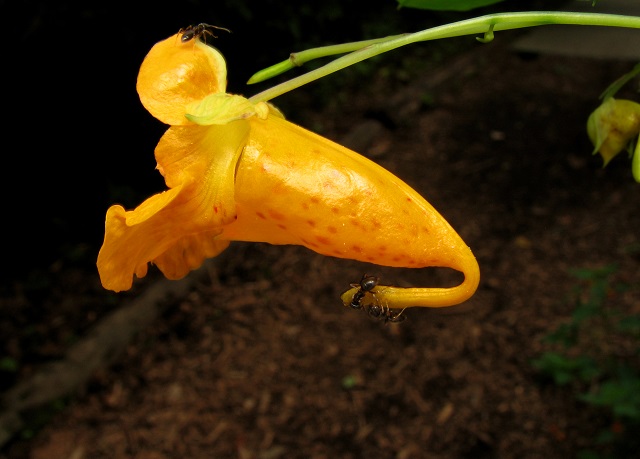
Jewelweed (Impatiens) also possess a spur. The flower itself is a small chamber just a little larger than a bumble bee. The petals form a curtain that slightly blocks the entrance to this chamber. Bumble bees are pros at collecting nectar from these flowers. Their plump bodies fit inside the chamber like a finger in a glove and their long and flexible tongues are suited to the curved spur.

Columbine.
© Beatriz Moisset

Columbines have not one but five spurs. Each petal is shaped like a long hollow horn ending on a knob. This is where the nectar gathers. Long tongued insects and hummingbirds pollinate these flowers. In most species, the flower nods or points downward, and the spurs point to the sky. This arrangement seems to be agreeable to their most common pollinators, hummingbirds.

Columbine.
© Beatriz Moisset
By contrast, the flowers of the alpine columbine remain erect, don't nod. They are also creamy white, a color favored by moths. And thus, they are preferably pollinated by large moths, the so called hawkmoths. A few other species of columbines, including the Colorado blue columbine, also face upwards and are also pollinated by moths.

Columbine and carpenter bee
stealing nectar
© Beatriz Moisset
Jewelweed and ants
stealing nectar
© Beatriz Moisset
This specialization has advantages but it also has some disadvantages. Not all flower visitors behave like honest pollinators. These difficult flowers are an invitation to cheating. Some visitors learn to take a shortcut, especially if their tongues aren't long enough to reach the bottom of the spur. They approach the flower from the side. Perhaps, they can smell the sweets through the walls of the spur. A quick bite or a stab through the delicate petal may be all it takes to reach the hidden food. Carpenter bees, bumble bees and even ants have been seen performing this robbery.


List of articles
Beginners Guide to Pollinators and Other Flower Visitors

© Beatriz Moisset. 2017

Monday, November 30, 2009

POLLINATORS IN WINTER. Fritillaries

Where do pollinators go in winter? When all the flowers that pollinators feed on are gone and when the cold grips the land, what do the pollinators do? They have to find refuges and hanker down until the next season. There are many different strategies at their disposal, many sheltered places, many options as to spend the winter months as eggs, larvae, pupae or adult. But they all make themselves invisible for several months of the year, hoping that no predator or parasite gets to them and hoping that the next season be bountiful and take care of their needs.
Here is just one example of a wintering pollinator, a pretty butterfly that you may see flitting around the garden during summer months: a fritillary butterfly Speyeria cybele.

Adult fritillaries are colorful butterflies of orange and black patterns, often mistaken for monarchs. Their long tongues enable them to reach for nectar hidden in long throated flowers such as horse mints, however they are not about to pass out a good opportunity to drink nectar from more accessible blossoms. You may start seeing them as early as May; by October they will be mostly gone or will look rather worn out, missing wing scales or even a piece of wing where a hungry bird took a stab and missed the body.
In late summer and early fall the females start looking for places to lay their eggs. Their babies feed exclusively on violets, so they need to find these plants and lay their eggs nearby. But by this time of the year violets are drying up or they are all but gone; only the roots remain under ground in many cases. This does not deter the egg laying females; either they have a formidable sense of smell that enables them to detect the roots of violets, or, in some cases, they just take a chance scattering their eggs on the leaf litter in shady places that are most likely to grow violets. In this case, some eggs will be lost, but there will be plenty left which will find their target.

The eggs are no bigger than a period at the end of this sentence; the caterpillar that emerges from it shortly afterward is about the size of a comma. Packaged inside this tiny body is all the genetic information needed to make all the colors and the beauty that will visit your garden fluttering from flower to flower during the warm months. There is no food for this baby during the winter months. So what is there to do? It promptly buries itself in the leaf litter seeking safety from the many small predators and parasites that hunt it in that dark and mysterious world that is the soil of your garden. There, it has nothing to do for several long, cold months; so it goes to sleep.

Probably many, perhaps most won’t make it through the winter; but the mother had laid so many eggs that there will still be plenty to keep the species going. By the end of winter it will be aroused, by some unknown cues. By then, violet plants are beginning to grow. Long before they start blooming, this caterpillar goes to work, feeding and growing for a couple of months. It will eventually emerge as a fully grown butterfly.

More on fritillaries life cycle in:
Pollinators welcome blog
Pollinator of the month
List of articles © Beatriz Moisset. 2012