Translate

Showing posts with label nectar. Show all posts

Monday, February 20, 2017

Spurs: Hard to Get Nectar

Violet.
© Beatriz Moisset
 Many flowers are very particular about their clientele. They have developed ways to make themselves attractive to certain flower visitors while discouraging others. They do so by adopting a certain shape. The spurs of many flowers serve this purpose. A petal or a sepal develops an elongated hollow spike. This is what botanists call a spur.

Violet (Viola mirabilis). Note the spur
Wikicommons. © Antti Bilund

Violets have a spur. Nectar is collected at its bottom. A pollinator needs a tongue long enough to reach the hidden nectar waiting in this special vessel. The rest of the flower is so designed that the insect gets covered with pollen while performing this task. If it is carrying pollen from a previous flower visit, it is likely to deposit it on the stigma. Only long tongued insects can take advantage of this flower and they need to develop an efficient way to approach this specially shaped blossom. After a few times they get better and better and proceed faster. The most common pollinators of violets are small, solitary bees.

Bumble bee visiting a jewelweed blossom
© Beatriz Moisset
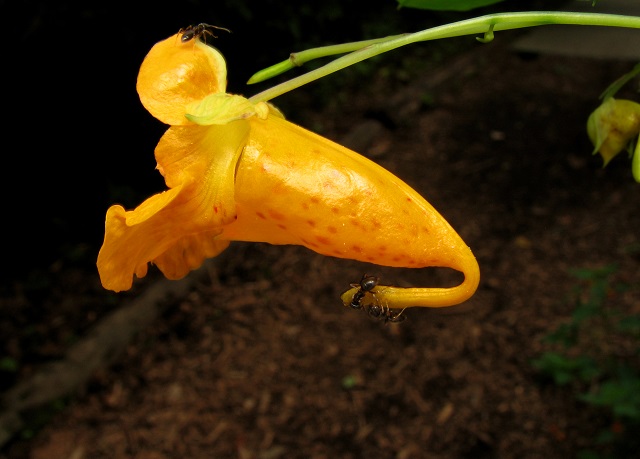
Jewelweed (Impatiens) also possess a spur. The flower itself is a small chamber just a little larger than a bumble bee. The petals form a curtain that slightly blocks the entrance to this chamber. Bumble bees are pros at collecting nectar from these flowers. Their plump bodies fit inside the chamber like a finger in a glove and their long and flexible tongues are suited to the curved spur.

Columbine.
© Beatriz Moisset

Columbines have not one but five spurs. Each petal is shaped like a long hollow horn ending on a knob. This is where the nectar gathers. Long tongued insects and hummingbirds pollinate these flowers. In most species, the flower nods or points downward, and the spurs point to the sky. This arrangement seems to be agreeable to their most common pollinators, hummingbirds.

Columbine.
© Beatriz Moisset
By contrast, the flowers of the alpine columbine remain erect, don't nod. They are also creamy white, a color favored by moths. And thus, they are preferably pollinated by large moths, the so called hawkmoths. A few other species of columbines, including the Colorado blue columbine, also face upwards and are also pollinated by moths.

Columbine and carpenter bee
stealing nectar
© Beatriz Moisset
Jewelweed and ants
stealing nectar
© Beatriz Moisset
This specialization has advantages but it also has some disadvantages. Not all flower visitors behave like honest pollinators. These difficult flowers are an invitation to cheating. Some visitors learn to take a shortcut, especially if their tongues aren't long enough to reach the bottom of the spur. They approach the flower from the side. Perhaps, they can smell the sweets through the walls of the spur. A quick bite or a stab through the delicate petal may be all it takes to reach the hidden food. Carpenter bees, bumble bees and even ants have been seen performing this robbery.


List of articles
Beginners Guide to Pollinators and Other Flower Visitors

© Beatriz Moisset. 2017

Thursday, September 18, 2014

Sneezeweed or Helenium


Halictid male bee on Helenium. © Beatriz Moisset
It is September, the days are getting shorter, the weather cooler. Plants put up a display that rivals or even surpasses that of spring. Asters, goldenrods, coneflowers and a number of other similar flowers create a golden explosion in gardens and meadows. Pollinators seem busier than ever, taking advantage of this bounty. Insect flower visitors love yellow and flowers seem to know it. They dress up in colors that attract their favorite visitors in the hope that they carry pollen to other flowers of the same kind. Pollinators, in turn, know that abundant resources await them in the bright yellow flowers.

Fig. 1. Three Helenium blossoms of different ages. © Beatriz Moisset
Let us look at one of these flowers in closer detail. Helenium, also called sneezeweed, has the same structure as sunflowers and asters, a crown of petals and a center made of little knobby structures called florets. Each one of those knobs is an entire flower which produces pollen and seeds. Each one needs to be pollinated in order to produce a seed. The dead heads you see later in the fall are little packages of these nutritious mature seeds that bring joy to passing hungry birds.

Fig. 2. Several Helenium or sneezeweed flowers. © Beatriz Moisset
The florets do not mature all at once. They proceed in an organized fashion from the outer ring to the center, row by row; they open and expose the pollen-carrying anthers and the pistils ready to receive pollen. They also fill up with nectar. Only one row or two at a time are ready to welcome visitors and to be pollinated. Bees know that. Even syrphid flies know that. You can see them moving from floret to floret until they complete the circle. Then they fly to the next blossom. They know enough not to waste time on the unopened flowers or the ones past their prime.

Bumble bee collecting pollen and nectar from open florets. © Beatriz Moisset
 Take a look at figure 1. The sneezeweed blossom near the center is quite fresh; most florets are still closed; only one is almost ready for pollination. The one in the upper right is halfway through; there are still some rows of unopened florets to go. The one below it is approaching old age, almost all done. Now, you can look at Helenium flowers and determine their approximate age just by looking at them. What do you think about the flowers in figure 2?

Another bumble bee. © Beatriz Moisset
 Smart pollinators, not only know where the food is in each flower, but also know that they will continue to find supplies in the following days. Bumble bees are known to faithfully come back to their favorite flower patches.

Sunflowers and asters do the same. See the following examples:

Agapostemon female on sunflower. © Beatriz Moisset


Halictid bee on coneflower. © Beatriz Moisset


Syrphid fly, Toxomerus on daisy. © Beatriz Moisset
 
Skipper on sunflower. © Beatriz Moisset


List of articles
Beginners Guide to Pollinators and Other Flower Visitors

© Beatriz Moisset. 2014


Tuesday, October 16, 2012

Ants, the Unlikely Pollinators

© Beatriz Moisset

Ants are seen visiting flowers with great frequency. People often ask me: Do ants pollinate? I answer with another question: What do you think? Are ants capable of pollinating flowers? Do they have what it takes to carry pollen from one flower to another, preferably of another plant?

Ants stealing nectar from the spur of a jewelweed. © Beatriz Moisset
Most pollinators can fly from plant to plant. Ants, lacking wings, don't go very far. Moreover, ants may be coated in some sort of antibiotics which may be detrimental to pollen. In some cases ants steal nectar from flowers, causing damage and reducing the likelihood of later pollinators' visits. Some plants resort to extrafloral nectaries, nectar-producing glands located in other plant parts, to keep the ants and other nectar robbers away from the valuable treasure reserved for legitimate pollinators.

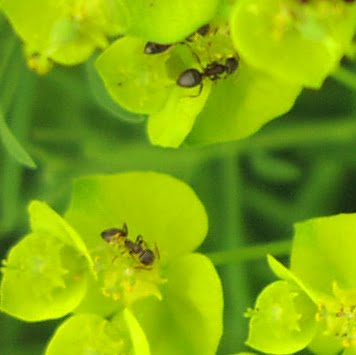
Ants pollinating wood spurge. © Beatriz Moisset
Despite all these drawbacks, there are instances in which ants are pollinators. One case is that of spurge, or Euphorbia. This plant grows very low near the ground and tends to intertwine its runners with those of nearby plants. This increases the chances of ants going from the flowers of one plant to those of another without the need to fly. Perhaps the pollen of spurge is more resistant to the chemicals on an ant's body. So, ants pollinate spurge; although, there are also small bees that perform this job just as well.

A few other plants, also low-growing, are pollinated by ants. Finally, there are some interesting cases of orchids pollinated by ants in Australia in a highly specialized way. So, yes, ants join the ranks of pollinators. They may even be the pollinators of choice for some plants in harsh, dry climates.

Ant on Queen-Anne-lace. © Beatriz Moisset

List of articles


© Beatriz Moisset. 2012 

Saturday, February 25, 2012

Robbers and cheaters and innocent bystanders

Bumble bee robbing nectar
Some flower visitors don't hesitate to rob nectar without paying their dues. They either don't bother or can't enter the flower the "legitimate" way, and thus, ensure picking up pollen along the way and delivering it to the next flower. Instead they take a shortcut, slashing the throat of the flower and going right to the source. Carpenter bees can be among the most notorious robbers because of their strong and sharp mouth parts that enable them to perforate the walls of a flower; but other large insects can be just as bad.

Abelia flowers with slashed throats
Tubular or trumpet shaped flowers are the most frequent victims of this larceny because their nectar is hard to reach. Here are some abelias that have been robbed. You can see the scar at the base of the flower.

Sometimes smaller bees or other insects take advantage of the shortcut and visit the wound, like this beetle, which also happens to parasitize the nests of bumble bees.

Sap-feeding beetle Epuraea aestiva
 In this case something more tragic happened. A small bug ventured deep inside the flower and became tangled, its legs sticking out of the hole, and unable to go in or out or turn around. I thought that I may be able to help it and by the way find out the identity of the victim; but my clumsy old fingers couldn't perform this delicate task. I never found out who this innocent bystander was. Any guesses?

An insect trapped inside the flower

List of articles
Beginners Guide to Pollinators and Other Flower Visitors

© Beatriz Moisset. 2012

Sunday, May 29, 2011

Nectar: Drink with a Zing?


We saw that floral nectars aren’t just empty calories (Nectar: Breakfast of Champions); they supply pollinators with valuable nourishment. The singular properties of nectar don’t end up there. When chemists continued analyzing the nectar of diverse flowers they found a few surprises.

In some instances caffeine or nicotine are added to the menu. Who would have thought! Then again, if bees love spilled Coca-Cola, it is perhaps for more than the sweetness. Do the clients of floral restaurants seek these stimulants? Do flowers find it important to indulge such demands? One thing is clear: some special ingredients in nectar must be important, both for the pollinator and the flower.

There are cases in which the sugar in nectar ferments into alcohol to the point that it may intoxicate thirsty flower visitors. Bumble bees visiting such flowers behave like drunken sailors, bumping clumsily into flower parts, shaking loose the pollen from the anthers and thus getting an extra dose of pollen dusting. Moreover, they neglect their fastidious grooming and remain rather dusty all over for some time. Perhaps this is beneficial to the flower which may end up getting more pollination under these circumstances. Nobody knows for sure but it is an interesting theory. I wonder whether the little gourmets develop a taste for certain vintages and visit more frequently the restaurants that deliver the desired beverage.

The flowers of a palm tree in Malaysia produce alcohol that can reach a concentration of 3.8%, comparable to some beers. And the tree smells like it! There is a little tree shrew, a fairly unusual pollinator, which visits these flowers assiduously. Up and down the trunk it runs visiting thousands of flowers. It is capable of drinking the equivalent of nine glasses of wine, day after day during the blooming season. Those who have studied this behavior claim that the animals show no sign of loss of coordination or similar consequences of heavy drinking.

Pollinators do a lot of traveling in their quest for nectar and pollen. They carry more than what is intended from flower to flower. Like tiny typhoid-Maries they are likely to pick up and spread pathogens along with their legitimate cargo of pollen. Nectar is the perfect culture broth for many bacteria and fungi. Flowers can become quite sick so they need to protect their precious reproductive organs against infections. It should come as no surprise that they can produce an assortment of antiseptics. There are substances in nectar that produce peroxide, the same disinfectant your mother used to apply to your scraped knees.


Perhaps the most mysterious thing is that some nectars carry bitter tasting substances and even toxins. What would be the purpose of that? Some of the bad tasting ones deter only some flower visitors, while they don’t bother others. Perhaps the plant is being selective, inviting only the most efficient pollinators and keeping others away. It is also possible that some pollinators can only tolerate a small amount of the bitter nectar, thus, abandoning the flower sooner and performing more pollination with less consumption of nectar. Let us remember that nectar production is an expensive investment for the plant.

Most plants produce toxins to protect leaves, stems, etc. against the hordes of herbivores. In other words, plants synthesize organic pesticides. Ordinarily they filter out these toxins from the nectar. But some accomplish this only partially. It seems like an unfortunate side effect, an instance of unintended contamination. Perhaps we are not the first ones to run into such a problem, plants made that blunder millions of years ago.


Nectar chemistry
Nectar, the first soft drink
Tiny treeshrews chug alcoholic nectar without getting drunk
Nectar, breakfast of champions

List of articles

© Beatriz Moisset. 2012

Saturday, May 21, 2011

Nectar: Breakfast of Champions


I used to believe that flower nectar was sugary water and not much else. That simple drink should be adequate for many of the insects that visit flowers. Sugar provides the fuel to power their flight, thus taking care of a fundamental need. Many insects have a very short adult life. They have already accumulated, during their larval life, most of the nourishment that they need as adults. In fact there are even some insects, such as the Luna moth, that do not feed at all as adults. Moreover, nectar drinkers often have other foods in their menu. For instance, bees collect pollen, as well as nectar, from flowers; wasps hunt insects. So it wouldn’t be surprising if nectar provided nothing more than sugar as a reward to pollinators.

I was wrong, but I wasn’t alone in my ignorance. Only recently, scientists have been able to study the chemistry of nectar, given the tiny amounts available for study. What they have learned in recent years surprised everybody. Nectar is a true cocktail including an assortment of substances, from nutritious to intoxicating, not to mention scented, colored or with preservatives. Flowers are known for the complexity and diversity of their shapes and colors. Now we know that their nectar can be just as rich in complexity and variety. Nectar drinkers seem to be connoisseurs of the restaurants they visit and flowers must have good reasons for developing such a complex menu to satisfy the demands of their clientele.

First of all the concentrations of sugars vary depending on a number of factors. Perhaps, the most important one is the most frequent visitors of a particular species. Butterflies and moths and some bees have very long tongues which they use like drinking straws. They visit flowers that provide a rather watery drink not likely to clog these very thin pipes. On the other hand, other insects, with shorter tongues, merely lap or slurp fluids and can take advantage of thicker nectar, richer in sugar.


In addition to sugar there are other substances in nectar. Like the power drinks used by athletes some contain ion supplements, such as potassium and sodium. Other common supplements of nectar are aminoacids, the building blocks of proteins. Let us remember that adult butterflies and moths cannot eat any solids. They have no chewing parts, only a long, thin tongue good enough for fluids and maybe the occasional pollen grain. As I mentioned before, most insects are short lived and may do fine without proteins in their diet, but the beloved monarch butterflies live for several months and have to make an arduous journey. They certainly need a well balanced diet; sugar alone would not suffice them.

There are other ingredients in nectar which I will discuss in future posts. I only want to mention here that in addition to nutrition, these substances may add flavor to this food making it more attractive to the pollinators and other flower visitors.

It is rather amazing to realize that we didn’t invent energy drinks; flowers did it millions of years ago. It gives me pause when I prepare to refill the hummingbird feeder. Are we turning our loved birds into soft drink junkies? Would they be better off without our help? I don’t feel too guilty because I know that they also feed on insects so they must be getting a balanced diet despite the empty calories at the hummingbird feeder. But, just in case, I will start growing plants for hummingbirds in my garden and cutting down on the junk food.


I can think of a few (natives only): butterfly weed, lobelia, beebalm, columbines, trumpet honeysuckle, penstemon, zinnia, nicotiana. Any suggestions?

Here is a list of “Top Ten” native hummingbird plants of the Operation Rubythroat web site.

Nectar, a drink with a zing
Nectar chemistry
Nectar, the first soft drink
Tiny treeshrews chug alcoholic nectar without getting drunk

List of articles

© Beatriz Moisset. 2012

Sunday, January 3, 2010

Floral Emissaries

The raising sun turns the meadow into multicolored blankets of sparkling dewdrops. One flower stretches its petals lazily; it is still too early. She sets the table with a scented tablecloth, arranges bowls brimming with nectar; the anthers full of pollen have burst open exposing their golden dusty treasure and she wonders: Will the visitors come? Sadly, the weather turns bitter and windy and the sun finally refuses altogether to come from behind the clouds; wrong weather for winged visitors.

The next morning the wind is gone; the sun begins to warm the land and melt the dew drops so our flower feels her hopes rise. She is not alone; many others show their charms letting their aroma float in the breeze with the same hope of attracting guests. Better this way, so the callers can carry love messages between them.

The sun keeps climbing and finally a buzzing sound announces the arrival of one of the anxiously awaited visitors. A shiny metallic green bee stops briefly at a nearby blossom and then comes to her. Wisely, she has painted darker lines that point the way to the hidden nectar; thus the guest has no trouble finding it and drinks it avidly and briefly. The cunning flower has prepared just enough nectar to attract a visitor, but not so much that the bee would become satiated and return home without further visits. The guest brushes accidentally against the anthers and some pollen sticks to its hairy body. This is no accident; the flower has placed things just right where she wants them; now her pollen will travel to other flowers.

A parade of winged travelers follows on the next few days. Not all of them are shiny bees, there are others: fuzzy bumblebees, flower flies, a few flashy butterflies and moths and even a beetle.

Finally the pollen is all gone and the anthers begin to wilt. But the flower isn’t done yet because deep inside the ovary, at the very heart of the blossom, sit the future seeds. Now the ovary begins to bulge and its tip at the end of a little tube, the stigma, glistens with a sticky substance meant to receive the pollen from other flowers, the love messages brought unwittingly by the visitors. So the flower keeps inviting guests with its nectar and hoping that they come loaded with other pollens and ready to leave some of their cargo behind. Pretty soon the grains that were left on the stigma will begin to make their way toward the carefully sheltered future seeds. Only now is the flower satisfied of a mission accomplished and only now she allows the colors to fade and the scent to disappear; the petals shrivel and will soon fall to the ground.

Only the ovary remains with its seeds and with all the promises of generations to come. Later on it will become a juicy berry that will attract another kind of visitors, hungry birds and other small animals; they will carry the seeds, adventurous explorers, to farther meadows, to a new life away from the mother plant. But, that is another story.


List of articles

© Beatriz Moisset. 2012

Saturday, January 2, 2010

For the Love of Flowers

Andrena, the bee, was sleeping her long slumber, comfortably inside her underground refuge, when something began to arouse her. She had been born the previous spring inside this cozy underground cell and she had grown well nourished by the mixture of flower’s nectar and pollen that her provident mother had stored. Later on, like the sleeping beauty, she had fallen into a deep trance for many months. But now it was spring and the soil was beginning to warm up. Did the warmth wake her up? Or was it some mysterious internal calendar? Suddenly that cozy cell that had been her nursery, her castle, her realm, her whole universe through the hot months of summer and cold ones of winter had become an intolerable prison. She had to get out.


Moved by this urge she began digging her way out. Her legs, never used before, were powerful enough to start loosening the earth that blocked her way to the outside world. With an unerring sense she moved toward the surface, perhaps following some ancestral memory of that world.

The task was arduous but she was young and strong and determined to find her way. It took her several hours and when her head finally emerged at the surface all her senses were bombarded by an accumulation of new sensations: light, colors, smells . . . She tried her wings for the first time and suddenly she found herself airborne. She marveled at her capacity for flying, zigzagging, rising and falling, making sudden turns. The surrounding world, immense and full of sunshine and strange sights, and her just discovered faculties were intoxicating. She kept coming and going taking notice of this unfamiliar land of her birth and its landmarks. She didn’t seem to get tired; there was so much to see. A hungry bird tried to catch her and missed, not because of her skill, but by sheer luck. She would learn to be cautious later on.

That morning she learned that she belonged to a small village of bees that, like her, were emerging from their prolonged sleep and getting drunk on light and air and new experiences. Their wings reflected the rays of the sun. Sometimes, if you walk on a meadow at the right time, you can see them against the sky like constantly moving dots of light.

A dogwood blossom makes a convenient waiting room for a group of boy bees spending the night together in wait for the girls

There were some males among them; some had emerged the previous day and now, past their first exhilaration they were moved by another urge that kept getting stronger by the minute. The scent of the females acted like a magnet and several, full of eagerness, approached and surrounded our little bee. She resisted their advances, not for lack of desire, which she was beginning to discover, but because she wanted only the best suitor. That would be her legacy to her children: the best father that she could find. One male prevailed over the others and joined with her. Now, in delirious ecstasy, both of them, linked by love, rose in the air and flew to a nearby branch where they could enjoy their time together in seclusion.

After their romance and carrying inside herself the sperm of the male, Andrena became all mother. Only one motivation would dictate her actions from now on: to ensure the best for her future children. She was passing on her mother’s heritage even though she would never know neither her mother nor her children.

She started the search for a nest site. What better place than the one her mother had chosen the previous year? It was a patch of soil, warm and with plenty of sunshine, safe from floods and not chocked by vegetation. She landed and started walking in circles looking for the best spot, but somebody else, perhaps her own sister, had already started setting housekeeping there. An angry buzz let her known that she was not welcome nearby. No problem, there were several similar spots not far from this one and she had no trouble finding a good one.

Andrena began digging the hard soil, just like her mother had done a year ago. It was harder than digging up from her cell; the soil was compacted and she had to use all the energy of her young jaws and legs. She kept working full of determination until she realized that she was getting hungry and thirsty.

She flew away from her nest searching for food. A delicious aroma told her that she had found what she was looking for. There were many flowers in the meadow, she landed on an open blossom, found its nectar guided by the scent and drank it thirstily. Andrena went from flower to flower until satiated, then returned to her task.

Back to work she went digging deeper and deeper. Evening came and she needed to rest. What better place than the tunnel she had dug? It was safe there and protected from the night chill. Andrena slept comfortably. The next morning, when her muscles were warm enough, Andrena resumed her work until something told her that she had arrived at the right place; then she started digging a side cavity, this one was a chamber like the one that had sheltered her through her infancy and long sleep.

A mother Andrena gathering food for her babies; her feathery legs make good baskets for the pollen

Now she needed to prepare the chamber for her offspring. That meant many trips to the meadow full of flowers. There she loaded rich pollen in the baskets on her legs and nectar, which she carried in her crop. It took her many trips to have enough for her purpose and another day passed by. She kneaded the pollen and nectar into a thick paste and made it into a tidy ball that nearly filled the whole cell. Satisfied, Andrena laid an egg on top of this loaf and sealed the chamber with some soil

Once again she kept digging another branch of the tunnel, making a new chamber, gathering food, laying a new egg and so on. The days flew by. Sometimes she couldn’t go to work because the weather was foul so she hunkered down, feeling safe in the darkness of her tunnel. One day our little bee escaped a sudden death without knowing it. When she approached a blossom she noticed something different but didn’t give it much importance. Fortunately for her, another bee beat her to this flower. Somewhat annoyed Andrena flew to another one without noticing that a crab spider had caught the other bee in her clutches and paralyzed her with her poison.

All that coming and going wore out her thin wings. They began to fray at the edges and so the day came when, after gathering her usual load of supplies in the meadow, she tried to take off but the extra weight and her aging body and worn out wings prevented her from doing so. She tried again and again but the wind kept slamming her against the ground. So finally, with a sigh and without regrets she surrendered to her fate, knowing that her mission was complete, the new generation was well provided and would repeat the story next spring.

Thus ended one little life made of flowers and sunshine, of dark tunnels and security.

List of articles

© Beatriz Moisset. 2010

Monday, December 28, 2009

POLLINATORS. Robbers and thieves

Some flowers allow only specialized pollinators. They place their nectar out of the reach of most visitors and only those with a long enough tongue can reach it. Such is the case of the bee balm or monarda; a flower visited by hummingbird moths and bumblebees
A hummingbird moth unfurls its long tongue and sticks it inside the equally long throat of a bee balm flower.

The tongue of a bumblebee isn't as long as that of moths or butterflies, but by burying itself into the flower this visitor can reach the store of nectar without difficulty.
These visitors approach the flower the "legitimate" way, meaning that they touch the pollen carrying parts and also the female parts of the flower by entering it this way. When they do so they carry pollen from some flowers to others and accomplish pollination. Everybody benefits; the insects get nourishment and the flowers are pollinated. However this flower's strategy may backfire when clever and lazy flower visitors take a shortcut and steal the nectar. One very common robber is the carpenter bee; with its powerful jaws it can easily slash through a flower's tissues. Here a female carpenter bee is opening the throat of a bee balm flower. When this bee goes directly to the nectar bypassing the sexual parts of the flower it doesn't pick up or carry pollen. As a consequence, it doesn't help the flower at all.
A carpenter bee stealing some nectar
Pollinators: Partners and Robbers
List of articles
© Beatriz Moisset. 2010

Thursday, October 8, 2009

A Busy Pollinator and a Relaxed One


An industrious little bee gathering food for her babies and pollinating flowers along the way. It methodically collects pollen without missing any and then promptly flies to the next flower.


The bee is very industrious and visits many flowers in a very short time. The flower fly, on the other hand, takes its precious time gobbling up pollen, so it visits fewer flowers overall.

Monday, September 28, 2009

BUMBLEBEES. Are Some Bumblebees Going the Way of the Dodo?

Who doesn't like a bumblebee? With their plump, fuzzy bodies and striking black and yellow or black and white stripes they easily capture people's hearts, especially when they are seen buzzing around from flower to flower.

What most people don't know is that some species of bumblebees are in decline. We have heard about the plight of its relative, the domestic honey bee; but haven't paid much attention to the situation of this wild cousin. Why should we care? It isn't just because bumblebees are charismatic, but also, and more importantly, because they play key roles in certain ecosystems. So far, we know of only a few species that are showing a reduction in numbers, both in North America and in Europe. It isn't as if all the species of bumblebees were going extinct overnight; fortunately some species are doing well, even in unexpected places such as suburban gardens. But, perhaps we should start paying attention to what is happening now rather than when it is too late. Besides, it is possible that many other species of wild bees are suffering similar declines in their numbers and we have no way to estimate what is happening because we know so little about them.

Here are some of the things that bumblebees do: they pollinate 15% of our food crops, worth about 3 billion dollars; they also pollinate countless wild flowers. Wildflowers are important not just for their beauty, but also for the seeds and berries that they produce. They become food for many species of wildlife, from birds and small rodents to large animals such as bears. Birds don't know what percentage of their food crops are pollinated by bumblebees, but it is possible that for some species is closer to 90% than to 15%. If we are not worried about our own food, we should worry about all the many species of birds and other wildlife that may be suffering because of a reduction on the numbers of wild bumblebees.

Goldfinches and many others owe their food to hard working pollinators such as bumblebees.
List of articles
© Beatriz Moisset. 2010