 |
Megachilid or mason bee, often used to pollinate fruit trees.
©
Beatriz Moisset
|
We frequently hear that "one bite out of three comes to
you courtesy of pollinators." Other times we hear it expressed as
"one bite out of three comes to you courtesy of bees," implying that
the bees in question are honey bees. Where did these statements originate? How
well documented are they? It all sounds plausible but I hesitate to cite
numbers without certainty when I give presentations about pollinators.
Fortunately a group at the
University of California at Berkeley decided to get to the bottom of it.
I am happy to tell you that they found the first statement to be fundamentally
accurate.
Claire Kremen, one of the coauthors of the study and member
of the Committee on Status of Pollinators, summarizes the results of their 2006
study as follows: "Out of the 115 crops studied, 87 depend to some degree
upon animal pollination, accounting for one-third of crop production globally."
Now, I can relax and go on telling my audiences that
pollinators are responsible for one third of our food. I can also face the
second claim, "one bite out of three comes to you courtesy of bees." This
claim originates from the confusion between pollinators, bees in general and
honey bees, and it is not accurate. Some information is in order.
 |
Augochlora pura bees.
©
Beatriz Moisset
|
Honey bees are the most important pollinators of agricultural
crops. They excel at pollinating a number of fruit trees such as apples, pears,
peaches and almonds. But they are not alone in this task. We owe a lot to all
the other carriers of pollen, 20,000 species of bees (4,000 in North America alone) and an assortment of wasps, moths,
flies and even bats.
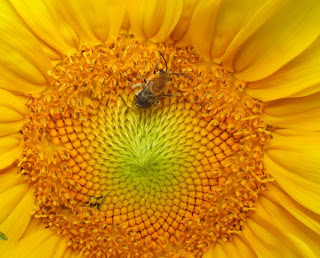 |
Anthophorini bee. It pollinates several crops.
©
Beatriz Moisset
|
Let us look at crops pollinated mostly or entirely by non-honey-bee
pollinators. Alfalfa is the most important one that comes to mind. No, we don't
eat alfalfa but cows, sheep, goats and even chickens do. Without alfalfa these
animals would be severely malnourished; they may not even survive. Most alfalfa
growers use the services of bumble bees, alkali bees and alfalfa bees or a
combination of the above plus a few other bees. These insects are well adapted
to the structure of alfalfa flowers and handle them efficiently. Honey bees, on
the other hand, are not fond of these blossoms and do a poor job. It may take several
honey bees to do the job of one alfalfa bee; but they make up in numbers what
they lack in finesse. This is why they are used in large alfalfa fields where
there is no habitat left for other bees, particularly in California.
When New
Zealand ranchers started raising cattle, they
also needed to grow clover for cattle feed. They had to purchase seed from
abroad every year because the plants failed to set seed for lack of pollinators.
European bumble bees were imported to do the job, and in fact they promptly
took care of the problem. Notice that it was bumble bees rather than honey bees
which were counted for this mission.
 |
Bumble bee buzz-pollinating azalea. © Beatriz Moisset
See video |
The flowers of tomatoes, eggplants, peppers and other
members of the potato family require special handling by the pollinator, a
process called buzz pollination. Bumble bees and other native bees do this
efficiently. Honey bees cannot, do not perform this maneuver. For a brief explanation
of buzz pollination see:
Buzz Pollination by Sue Rosenthal.
Blueberries and cranberries are mostly buzz pollinated.
Unfortunately, large fields of these crops provide no habitat for the native bees
and bumble bees which are most adept at this task. Under these circumstances, honey
bees are used as pollinators despite their poor performance.
 |
| Yucca moth, a highly specialized pollinator. © Beatriz Moisset |
Figs are pollinated by fig wasps, yucca by yucca moths, and mangoes
by bats. A few other specialty crops use the services of specialized insects. Several species of flies are used to pollinate some crops such as onions and cabbage. Honey bees, or even other bees are not involved here, either.
In summary, we must remember to give credit to all
pollinators. Let us thank them all. My favorite one is not a honey bee, not
even a bee. It is the little
fly, or midge, that pollinates the
cacao flowers.
What would the world be without chocolate?


