Translate

Friday, May 31, 2013

One Bite out of Three before Columbus


Bumble bee on pumpkin flower © Beatriz Moisset. 2013
Only recently we have opened our eyes to the importance of pollinators in food production. The interest keeps growing almost daily. We often hear it expressed as "we owe one bite out of three to pollinators."

As I mentioned in the previous post, many assume that the honey bee is responsible for all that pollination. Not so! We must remember that the domesticated bee was brought to this continent in the 1600s by European colonists. It was introduced to California even later, in the 1850s. Who did all the pollination before? Was it as necessary then as it is now?

I suspected that the "one bite out of three" was just as valid before the introduction of the honey bee as it is now. I decided to learn about the pollinators that did all the work in pre-Columbian days. First, I searched for information on Native Americans' food plants and then studied how these plants were pollinated. You can immerse yourself on Daniel Moerman's list of 1,500 plants (Native American Ethnobotany Database) or read a shorter list of plants used by peoples of the North East. I will limit myself to painting a picture with an extremely broad brush starting with the most important food sources.

Beans were one of the Three Sisters that Native Americans cultivated © Beatriz Moisset. 2013

In large part of North America the native peoples cultivated the so called Three Sisters: corn, squash and beans. Corn is wind pollinated. But the other two need the help of bees. The squash bee and a variety of solitary bees and bumble bees pollinate the so called vine crops: pumpkins, squash and other gourds. Beans, all varieties of them, also need the help of native bees and bumble bees to produce a crop.
Bumble bee on sunflower © Beatriz Moisset. 2013
Sunflower, another staple of Native Americans, is also bee pollinated and so are blueberries and cranberries and nearly all other berries. Chestnuts, abundant in pre-Columbian times, were a significant part of the diet all along Eastern North America. Unfortunately, the American chestnut has gone almost extinct in the last century, so we don't know much about its pollinators. But the European and the Chinese chestnuts are pollinated by bees. We can be quite confident that it was the same with American chestnuts.
Studying the pollinators of camas lilies in Oregon © Beatriz Moisset. 2013
In the West, the tubers of camas lilies were of great importance to local tribes. Their delicate blue flowers attract a number of insects, many of which serve as pollinators.
Common milkweed was eaten by Native Americans after removing the toxins
© Beatriz Moisset. 2013
Among all the other plants listed on the references given above, I have picked just a few examples of those that require insect pollination: mints, milkweeds, passion flowers, spring beauties and prickly pears.

In South America, all the members of the tomato and potato family are insect pollinated. Figs, cashew nuts, cacao and a number of tropical fruits also require the services of pollinators, not just insects but even hummingbirds and bats.

Of course, Native Americans ate animals in addition to plants. Some of this food also depended indirectly on pollinators. I will limit myself to one example, that iconic bird that represents one of the early interactions between European colonists and natives: the turkey. It feeds, in part, on insect-pollinated berries, crabapples, seeds, roots and nuts.
Wild turkeys © Beatriz Moisset. 2013
Pre-Columbian diets depended on pollinators just as much as present day diets. Native pollinators continued to do a good job when farms and orchards were small. However, in recent times, the Old World domestic bee has become the most important pollinator of American crops because of the development of modern agricultural methods. The role of the native pollinators could be restored by creating the right conditions for them, such as providing nesting sites and reducing pesticides, near crop fields. The Pollination Conservation Resource Center of the Xerces Society and the PollinatorPartnership among other organizations are committed to these goals. You can find valuable resources in their respective websites.

Friday, May 24, 2013

One Bite out of Three


Megachilid or mason bee, often used to pollinate fruit trees.
© Beatriz Moisset

We frequently hear that "one bite out of three comes to you courtesy of pollinators." Other times we hear it expressed as "one bite out of three comes to you courtesy of bees," implying that the bees in question are honey bees. Where did these statements originate? How well documented are they? It all sounds plausible but I hesitate to cite numbers without certainty when I give presentations about pollinators.

Fortunately a group at the University of California at Berkeley decided to get to the bottom of it. I am happy to tell you that they found the first statement to be fundamentally accurate.

Claire Kremen, one of the coauthors of the study and member of the Committee on Status of Pollinators, summarizes the results of their 2006 study as follows: "Out of the 115 crops studied, 87 depend to some degree upon animal pollination, accounting for one-third of crop production globally."

Now, I can relax and go on telling my audiences that pollinators are responsible for one third of our food. I can also face the second claim, "one bite out of three comes to you courtesy of bees." This claim originates from the confusion between pollinators, bees in general and honey bees, and it is not accurate. Some information is in order.

Augochlora pura bees.
© Beatriz Moisset
Honey bees are the most important pollinators of agricultural crops. They excel at pollinating a number of fruit trees such as apples, pears, peaches and almonds. But they are not alone in this task. We owe a lot to all the other carriers of pollen, 20,000 species of bees (4,000 in North America alone) and an assortment of wasps, moths, flies and even bats.
Anthophorini bee. It pollinates several crops.
© Beatriz Moisset
Let us look at crops pollinated mostly or entirely by non-honey-bee pollinators. Alfalfa is the most important one that comes to mind. No, we don't eat alfalfa but cows, sheep, goats and even chickens do. Without alfalfa these animals would be severely malnourished; they may not even survive. Most alfalfa growers use the services of bumble bees, alkali bees and alfalfa bees or a combination of the above plus a few other bees. These insects are well adapted to the structure of alfalfa flowers and handle them efficiently. Honey bees, on the other hand, are not fond of these blossoms and do a poor job. It may take several honey bees to do the job of one alfalfa bee; but they make up in numbers what they lack in finesse. This is why they are used in large alfalfa fields where there is no habitat left for other bees, particularly in California.

When New Zealand ranchers started raising cattle, they also needed to grow clover for cattle feed. They had to purchase seed from abroad every year because the plants failed to set seed for lack of pollinators. European bumble bees were imported to do the job, and in fact they promptly took care of the problem. Notice that it was bumble bees rather than honey bees which were counted for this mission.
Bumble bee buzz-pollinating azalea. © Beatriz Moisset
See video
The flowers of tomatoes, eggplants, peppers and other members of the potato family require special handling by the pollinator, a process called buzz pollination. Bumble bees and other native bees do this efficiently. Honey bees cannot, do not perform this maneuver. For a brief explanation of buzz pollination see: Buzz Pollination by Sue Rosenthal.

Blueberries and cranberries are mostly buzz pollinated. Unfortunately, large fields of these crops provide no habitat for the native bees and bumble bees which are most adept at this task. Under these circumstances, honey bees are used as pollinators despite their poor performance.
Yucca moth, a highly specialized pollinator. © Beatriz Moisset

Figs are pollinated by fig wasps, yucca by yucca moths, and mangoes by bats. A few other specialty crops use the services of specialized insects. Several species of flies are used to pollinate some crops such as onions and cabbage. Honey bees, or even other bees are not involved here, either.

In summary, we must remember to give credit to all pollinators. Let us thank them all. My favorite one is not a honey bee, not even a bee. It is the little fly, or midge, that pollinates the cacao flowers. What would the world be without chocolate?

Importance of pollinators in changing landscapes for world crops

List of Articles 
Also, see Bees and Vitamins. The importance of pollinators goes beyond the "one bite out of three" to our basic nutrition needs.
Update to pollinators and vitamins: Contribution of Nutrients by Pollinators
One Bite out of Three and Wildlife
One Bite out of Three before Columbus

Beginners Guide to Pollinators and Other Flower Visitor

© Beatriz Moisset. 2013
 

Thursday, May 9, 2013

Honey Bees, Almond Pollination and Corn Fields


Trucking bees for pollination purposes. © David Green, Wikicommons
I have pondered about the connection between almond crops and honey bees in North America. I found another piece of the puzzle in the Bee Informed website: corn fields play an important role on the problems that honey bees face.

After bees are done pollinating crops, they need to restore the energies and supplies spent on all the traveling and waiting and monoculture feeding to which they have been subjected. Many bee hives used to be taken to the prairies of North Dakota where they used to find abundant wild flowers. But that resource is getting smaller all the time, the reason being that each year a larger area is devoted to corn cultivation.

More and more it seems that the most serious problem honey bees face is the agricultural system. Pesticides play an important role in this matter, but agribusiness also has a lot to do with it. Almond fields are becoming more and more like factories and less like orchards. The practice of using massive numbers of just one species of pollinators is also becoming a factory process.  Are we expecting too much from honey bees? Shouldn't we be changing agricultural practices? Is it time to resort to organic farming? Shouldn't we take advantage of all the many pollinators which would prosper if given adequate habitat near the crops?

Some resources on alternative pollinators:
Sare

List of Articles 


© Beatriz Moisset. 2013

Friday, April 12, 2013

Flower Visitors

A useful guide for those who want to know more about the little visitors to the flowers.
An illustrated beginner's field guide to insect flower visitors, including pollinators. The guide provides concise descriptions, photos and life history information of the most common insects found visiting flowers. It includes time of year, geographic area and favorite flowers. Also mentioned are those that act as pollinators and whether they may sting.


Guide to Flower Visitors
Available at Barnes and NobleLulu.com and iTunes


© Beatriz Moisset. 2013

Thursday, April 4, 2013

What is the Connection Between Honey Bees and Almond Farming?


Honey bee. © Beatriz Moisset

These days we hear a lot about Colony Collapse Disorder (CCD) and other problems that plague bees and cause their numbers to plummet. We also hear about the concern for crops, that of almonds in California, in particular. Every year millions of bee hives are shipped to California to provide pollination for almonds during the brief period of their bloom. Beekeepers know that transporting bees and making them pollinate a monoculture such as almonds are stressful to them.

Statistics about the declining numbers of bee hives are confusing, at least to me. Some vary widely but they all indicate that numbers are down and continue to drop. What I find confusing is that you frequently hear about repeated annual losses of 50% or so. This would mean that, in a few years, bee populations would bee reduced to insignificant numbers. But this is not exactly what is happening. The situation is bad, but not extreme. This USDA graph published by Yale Scientific Magazine may help clarify things. Bear in mind that statistics refer only to honey-producing hives, not to hives used for crop pollination. There has been a decline of about 50% in the last 50 years, the most dramatic drop took place in the 1980s, when parasitic mites arrived in the US. Unfortunately, the graph doesn't cover recent years, though.

Even more puzzling is that, although the numbers of bees have been dropping, the acreage of almond cultivation has been growing dramatically in recent years. CCD or not, almond crops continue to be pollinated by honey bees.

According to the Food and Agriculture Organization of the United Nations the area covered with almond trees in the United States in 1969 was 151,000 acres (62,000 hectares). Recent statistics by the USDA (2012 California Almond Forecast) show a steady growth of acreage dedicated to almond trees in California, from 418,000 acres (169,000 hectares) in 1995 to an estimated 780,000 acres (316,000 hectares) in 2012. In summary, almond cultivation in California has grown about 500% in the past 40 years.

Spring in the Orchard
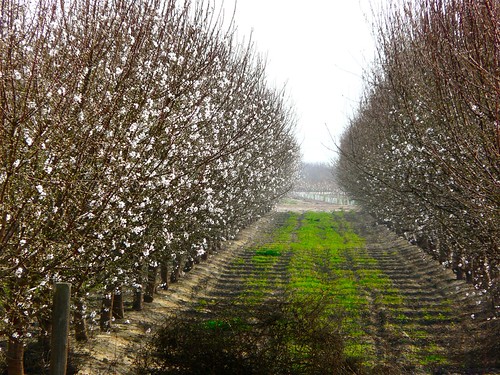
Note the bare ground under the trees, sign of herbicide use  © Kelsey J Nelson. 2010 Flickr

My questions are: how do diminishing populations of honey bees manage to pollinate increasing numbers of almond trees? Does transporting bees annually have something to do with this pollinator's difficulties? We know that this is stressful to the insects. We also know that the convergence of so many hives from so many areas of the country into one point is conducive to the spread of pathogens. So, perhaps, this practice is contributing to the problems that bees face.

I have no answers, but hope that somebody out there does.

© Beatriz Moisset

Monday, March 4, 2013

Pollinators of the American Chestnut


American Chestnut Pollen Stalks: Photo by Timothy Van Vliet
 "And the blossoms gave up one of the best honey crops we ever had." said Noel Moore of Rabun County, Georgia, in 1980 when asked about his memories of the American chestnut. He added mournfully: "We've never had a honey crop like we did since the chestnuts died, because there's not that much nectar in the wild now. Whenever chestnuts bloomed, in the morning, early, the trees looked like just the whole tops were alive with honeybees working on getting the nectar."

The American chestnut, Castanea dentata, became virtually extinct as a species, almost entirely gone from the Eastern United States by the 1950s. Before that time it had represented 25% to 30% of the forest canopy from Maine to Georgia. An infestation arrived from Asia, probably introduced with Asian chestnut trees brought by horticulturists. A fungus, first noticed in 1904, but probably already present in several areas of this country, had become a killer of native chestnut trees.

The Asian chestnut species has coexisted with the fungus for millions of years and has developed ways to withstand its attacks; but the American chestnut is helpless. To make things worse, the fungus spores travel easily through air and show great resistance to weather changes. So, what came to be known as the American chestnut blight spread through the entire range of this species killing nearly all the trees in less than half a century.

Many species that depended on the nuts for food, from chipmunks to bears, experienced significant losses. In fact, populations of squirrels and wild turkeys crashed. Squirrels bounced back on their own, but turkeys needed human assistance. The effect traveled up the food chain. Goshawks and other predators felt the impact. Gone with the chestnut trees, although less noticed by most, were some insects that fed on this tree; probably seven species of moths became extinct.

Humans also suffered the loss grievously. Not only the nuts but the timber were valued and now they were gone. Dedicated scientists and agronomists of the Department of Agriculture fought for years to slow down or stop the march of the parasitic fungus, resorting to a variety of methods to heal the trees or to introduce pests that weakened the fungus. All were futile.

What happened to the pollinators of this species? Pollination research was almost non-existent when the trees were abundant and now that they are almost gone nobody is gathering such information. That is why I was glad to read the observations of one old enough to remember what things were like when the tree was still alive. His comments show that non-native honey bees visited the flowers in huge numbers. But, what about the native pollinators, the ones that had lived for thousands of years with the tree and its flowers?

For lack of American chestnut trees, we can use proxies, the closest relatives of the deceased, to gather some indirect information on their pollination . The flowers of species of chestnuts are strongly scented and attract numerous insect visitors, not just honey bees, but also many species of solitary bees, butterflies, flower flies, and beetles. Specialist honey producers sell a monofloral honey made from blossoms of the European chestnut, Castanea sativa. It is strong tasting and darker than other honeys. Chinese chestnut trees, Castanea mollissima, grow in some gardens and parks where I regularly go for walks. The scent of their flowers is almost overpowering in the months of May and June.  

We can assume that American chestnuts were also visited by many insects and that they were pollinated by them. They too must have suffered from the near disappearance of the species. Some of them may have been able to adapt and resort to pollen and nectar from other plants although no other trees bloom as heavily as chestnuts in late spring and early summer. The American chestnut disappearance must have been a severe blow to all of them. Perhaps some of them, too, went nearly or totally extinct. Probably we'll never know.

The struggle to bring the chestnut back from its near extinction continues. Horticulturists are resorting to a variety of approaches, from controlling the virulence of the fungus to breeding new varieties of the tree in an attempt to restore the American chestnut to its native geographic range. Some strategies look more promising than others. All require enormous effort. Let us hope that they succeed.

Thursday, November 1, 2012

Monarchs and their Enemies


Male monarch butterfly. © Beatriz Moisset

We are told that monarch butterflies are well protected against predators and indeed they are. Their caterpillars feed on milkweeds, rich on highly toxic substances known as cardenolides. Having developed resistance against these chemicals, the monarchs themselves are poisonous so predators avoid them. A young, inexperienced bird that takes a bite off of a caterpillar or a butterfly spits it out in disgust and may be sick afterwards. It learns its lesson after no more than one trial.

Are monarchs completely free from enemies, then? Not so, there are exceptions. A number of predators and parasites have also become tolerant or immune to the cardenolides. Thus, they can feed on monarchs with relative impunity. The list of predators includes birds, mice and insects. Monarchs can also become victims of certain pathogens.

Robin. © Beatriz Moisset
Brown thrashers, grackles, robins, cardinals, sparrows, scrub jays and pinyon jays are known to feed on monarchs. Some of these birds avoid the body parts with higher concentrations of cardenolides by eating only the abdomens or by eating this kind of food in moderation. When monarchs arrive in their wintering grounds in Mexico they are plump with stored fats that will keep them through the winter. A whole new set of predators is eagerly awaiting them. Mice feast mostly on dead and dying butterflies that have fallen to the ground. Several species of birds, especially black-backed orioles and black-headed grosbeaks take a heavy toll on the millions of wintering butterflies. A few months after their arrival in Mexico, the monarchs may have lost a fair amount of toxins, making them more appetizing. It is estimated that between 7 and 40% of them fall victims to predation in their roosting grounds.

Small milkweed bug. © Beatriz Moisset

Invertebrates may be worse than mice and birds at decimating the populations of monarchs. Eggs, caterpillars and pupae are all vulnerable. The small milkweed bug doesn't just eat milkweed. It becomes carnivorous in occasions and catches milkweed caterpillars.

Spined soldier bug. Podisus maculiventris. © Beatriz Moisset
The spined soldier bug is an indiscriminate predator of many species and is not averse to feeding on monarchs. It impales caterpillars larger than itself and feeds on the internal fluids. (View of a spined soldier bug feeding on a monarch caterpillar).

Polistes paper wasp. © Beatriz Moisset

Paper wasps, Polistes, sometimes attack monarch caterpillars or pupae to feed their young. Recent reports suggest that this form of predation is more common than originally thought. (View of several paper wasps collecting food from a monarch chrysalis).

Asian lady beetle or ladybug. © Beatriz Moisset

In addition to all these native predators, the introduced Asian lady beetle is becoming a serious enemy of monarch eggs and caterpillars.

Tachinid fly. © Beatriz Moisset

Several tachinid flies and parasitic wasps lay their eggs on the monarch caterpillars for their larvae to feed on. All these insect predators and parasites probably consume a substantial number of monarchs before they even reach maturity.


Parasitic wasp, Pteromalid. © Beatriz Moisset

You may feel sorry for the monarchs; but this is the way of nature. Everything is interconnected and monarchs are not the exception. Sad as it seems, these butterflies serve a purpose by being part of the food chain. They produce enough eggs to survive and prosper despite the attacks. They could go on for thousands of years as they have already done, feeding on milkweeds and providing food for other forms of wildlife. The biggest threat to them does not come from those that feed on them but from the changes we are introducing in the planet.

Another frequent enemy of monarch caterpillars is a predatory stink bug, Stiretrus anchorago (Anchor stink bug).

Further readings:
Parasites Affecting Monarchs. University of Georgia
Parasites and Natural Enemies. University of Minnesota
A Butterfly's Flashy Colors.


List of articles

© Beatriz Moisset. 2012