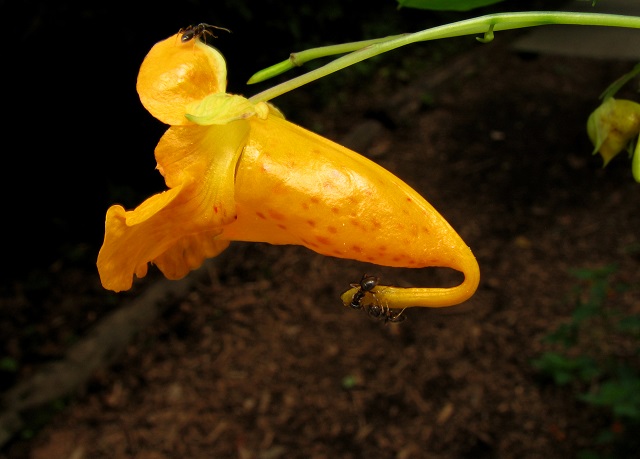
Flowers have maintained a partnership with insect pollinators from the beginning. They are masters at attracting these love messengers and perpetuating the species through pollination. They use countless ways to accomplish this goal.
Translate
Thursday, May 23, 2019
Saturday, March 9, 2019
Bees and Stingers
Life
is hard for pollinators. Well, life is hard for all creatures, not
just animals but plants, too. They are all food for other creatures.
Leave it to Jonathan Swift to put this concept in a nutshell. He
tells us on Poetry, a
Rhapsody
“...every
creature
Lives
in a state of war by nature...”
And
explains further:
“So,
naturalists
observe,
a flea
Hath
smaller
fleas
that on him prey;
And these have
smaller still to
bit'em;
And so proceed
ad infinitum.”
This is why every
creature needs to invest on defenses in order to survive and to pass
its genes to the next generation. This is also true of pollinators.
We can use bees to illustrate this point, just as Jonathan Swift used
fleas. They have a whole array of defenses, some of them we don't
even know much about. So let us take a look at the better known one,
the stinger.
Bees use their
stingers in self defense and in defense of their brood. They don't
use them for any other purpose. A stinger is located at the rear end
of a bee. It is not like the sharp tongues or jaws of other insects
like mosquitoes, horse flies or fleas. These insects use their
piercing mouth parts for an entirely different purpose, primarily to
obtain nutrition in the form of blood.
![]() |
Ichneumonid
wasps have an impressive appendage
at
the rear end, but it isn't a stinger.
It is
used only to lay eggs and it is called ovipositor
|
A stinger has a
long and peculiar evolutionary history. Many millions of years ago
there were wasps, ancestors of present day wasps and bees, which did
not have stingers. They did have a long, pointy tube at the end of
the abdomen which they used for laying eggs and got the name of
ovipositor. Many wasps still use it for this only purpose. They
inject an egg inside the body of another insect, for instance a fat,
nutritious caterpillar. The wasp's baby grows surrounded by food and
well protected inside the body of its victim. Ordinarily, it ends up
killing its host. This is why they are considered something between a
parasite and a predator and they are called parasitoids. Their
victims are called hosts.
The hosts, in
turn, developed defenses against their enemies. Many of the larvae
hide themselves inside plant stems or under bark. So the wasps, had
to come up with ways to overcome these defenses. Their ovipositors
became stronger and longer. Other victims were able to fight back by
squirming or biting their attackers back. So the wasps evolved
substances that they could inject along with the egg. These
substances paralyze the victim without killing it. Thus the progeny
has fresh food at its disposal, rather than a decomposing corpse. And
here is where the ovipositor took a curious turn.
In some insects it
stopped being an ovipositor and became a syringe loaded with toxic
stuff. Its function became purely defensive. The wasp found other
means to lay her eggs bypassing the stinger. This happened many
millions of years ago. All the descendants of those early wasps are
what we know as stinging wasps and bees; ants also belong in this
category. They all have a
modified ovipositor which doesn't serve that purpose anymore.
The stinger took
another turn. Bees don't attack prey. Their ancestors used to chase
insects that were feeding on flowers. At some point, they discovered
that flowers' pollen is so nutritious that it was preferable to feed
this to their brood and not bother hunting animal food. In other
words, they became vegetarians. However, they did not give up the
stinger. They kept it for defense purposes. Obviously, only females
have this weapon. Males never had an ovipositor and as a consequence
they don't have a stinger either and can't sting you.
One wonders why
females have such a formidable defensive weapon while the males
don't. The answer seems to be that males are shorter lived. Once they
have mated there is no further use for them. The females, on the
other hand have to raise a family. They need to defend the nest and
the future generation, not just themselves.
I read recently
that the budget for defense is bigger than all the other budgets put
together, such as all the sciences, arts, education, the environment
and so on. How is this possible? Later on, I thought that we are not
all that different from the rest of the world, and I mean the entire
living world, plants and animals, not just humans.
Thursday, September 21, 2017
A Butterfly's Flashy Colors
![]() |
|
Male monarch butterfly
(Danaus plexippus)
© Beatriz Moisset
|
People fall in love with monarch
butterflies because of their bright black and orange pattern. Many
monarch enthusiasts are busily raising these butterflies in their
gardens and homes. Some have become real experts on these insects and
their life cycle. They are profoundly distressed when something goes
wrong and one of them fails to make it to adulthood and freedom.
Some particularly despise butterfly
enemies. If they catch a predatory bug sucking the juices out of an
unfortunate caterpillar, they rage against the predator. Parasitic
flies also generate a violent reaction. It is hard
to believe, but monarchs
owe their
beautiful colors to their enemies. Here is the whole story.
Monarchs feed on
milkweeds. They are dependent on these plants and cannot digest
others. Milkweeds, like many plants produce powerful toxins as a
defense against herbivores. These toxins go by the name of cardiac
glycosides because they cause heart paralysis. As an additional
defense they produce a sticky milky-looking substance that gives them
their name. The milk is present in most tissues of the plant and
bleed easily, gumming the yaws of a hungry attacker that tries to eat the milkweed plant.
This
is enough to deter most plant eaters, but
monarch butterfly caterpillars and more than a dozen other creatures
have learned to overcome such defenses.
Earlier milkweeds, millions of years ago, had milder forms of the
toxins. That
was all they needed, but some early
insects learned to tolerate them and proceeded undeterred to feed
from these plants. Thus, milkweeds were forced to create stronger and
stronger glycosides and, in turn their feeders found ways to deal
with the more powerful toxins. Arms races of this type abound in the
natural world.
The monarch
butterfly adapted itself to these plants by
several means: it avoided the most toxic
plants or their most toxic parts; it developed enzymes that could
deal with the toxins, or it stored them in parts of its body where
they could do no harm. In doing all this, it became dependent on
milkweeds. This dependence added a bonus to the monarch's survival,
its body is loaded with bad tasting, toxic glycosides, which constitute a powerful defense against its enemies. Most predators
avoid the toxic butterfly. However a handful of these predators
developed ways to handle the monarch's toxins by eating only the
parts with less glycosides, or by evolving enzymes that neutralize
these toxic substances. This is another case of the arms race at
work.
This is not all. The
monarch advertises its toxicity and horrid taste to possible
predators. Birds who never saw a monarch butterfly before eagerly
take a bite of one. The immediate reaction is that of disgust,
spitting up the morsel and shaking their heads or rubbing their beaks
in an effort to remove the unpleasantness. They have no trouble
remembering the strikingly
colored creature and its bad taste. They are not likely to repeat
such experience.
![]() |
|
Large milkweed bugs
(Oncopeltus fasciatus)
on milkweed seed pod.
Adults and nymphs
© Beatriz Moisset
|
![]() |
|
Milkweed beetle (Tetraopes
tetrophthalmus)
© Beatriz Moisset
|
![]() |
|
Dendrobatid frog, Peru
© Tim Ross. Wikicommons
|
![]() |
|
Polished Lady Beetle
(Cycloneda munda)
Ladybeetles are another
example of
brightly colored bad
tasting insects
© Beatriz Moisset
|
So, as I said at the
start, a monarch's lovely colors are due to a constant battle with
their enemies. In a perfect world (perfect for monarchs, that is)
these butterflies wouldn't need to be loaded with toxins, nor would
they need to tell their enemies to keep away. In such a perfect
world, monarchs would have plain colors. Is this what we want?
Further readings:
|
The monarch caterpillar is
also toxic
and also has bright
warning colors
© Beatriz Moisset
|
Further readings:
Labels:
aposematic colors,
Asclepias,
butterfly,
defenses,
longhorn,
milkweed,
monarch butterfly,
predator
Sunday, September 3, 2017
Imitation is the Best Form of Protection in Some Cases
| Not a bee, but a mimic, the fly Eristalis. © Beatriz Moisset |
A stroll among the flowers allows me to
see numerous bees of different sorts, zipping along from blossom to
blossom. Just as numerous are other winged insects that look very
much like bees. The experienced eye recognizes them for what they
are, flower flies impersonating the stinging insects. But those
unfamiliar with bees or with insects, in general, may assume that
these flower flies are bees. They may even recoil in fear of a sting
although the flies are innocuous, lacking such powerful weapon.
![]() |
| A wasp mimic, Spilomyia sayi © Beatriz Moisset |
Those flies who imitate bees or wasps have a reason
for playing this masquerade. They are not interested in fooling us,
humans. Their deception is aimed at their predators, mostly birds.
However, the ruse is so effective that it even we fall for it.
Syrphid flies, also known as flower
flies or hover flies, are almost as assiduous in visiting flowers as
bees are. They drink nectar and sometimes also feed on pollen.
Although not as efficient as bees as pollinators, they deserve some
credit and occasionally their contribution to pollination is
significant. Another group of flies that visit flowers with great
frequency includes the so called bee flies.
Both, flower flies and bee flies mimic
bees or, in some instances, wasps. The imitation is very specific in
some cases. The so called drone fly, Eristalis tenax, looks
like a honey bee. The name is appropriate, considering that male honey bees, drones, have large eyes, and these flies have even bigger
eyes. Both, the fly and the honey bee are European. The imitator
evolved along with its model in that continent. Another European
flower fly that mimics honey bees effectively is the narcissus fly,
Merodon equestris.
Other flower flies and also a robber
fly imitate bumble bees. They have a furry coat and even buzz like
bumble bees.
![]() |
| Bumble bee mimic, Mallota bautias © Beatriz Moisset |
The smaller flies, members of the
Syrphinae subfamily apparently are mimics of some or another of the
many solitary bees. In most cases one cannot be sure of the model
chosen for this mimicry.
| A honey bee, the model for many mimics © Beatriz Moisset |
It is a peculiar thing that some
imitations are extremely good, while others are rather general in
character. Biologists speculate that even a not-so-good imitation may
serve the purpose of deceiving the enemies and this is why such types
of mimicry persist in nature. It is also possible that the predators
don’t see exactly what we see and the mimicry is convincing enough
for them.
This is just one type of mimicry. Other
insects take the appearance of their surroundings, which makes them
nearly invisible. Still others look like bird poop, not an appetizing
sight for a snack seeker. Stay tuned for descriptions and
illustrations of more of these ingenious survival mechanisms.
References
Tuesday, February 21, 2017
Unexpected Liaisons, Mites and Bees
![]() |
Mason bee with phoretic
mites
|
We
think of mites as annoying tiny parasites that cling to us
and make us
itch. If we see an insect covered with mites we feel sorry for it,
assuming that the poor thing must be itching terribly and being
weakened by the blood sucking pest. This is true in most cases, but
curiously there are some exceptions. Believe it or not, some bees,
wasps
and beetles
are perfectly happy with such companions. They bus around the little fellows from plants to nests. This earn the passengers the name of phoretic mites.
Carpenter bee (Xylocopa) with
phoretic mites
Wikicommons ©
Gideon Pisanty
|
Mites
and ticks are not insects. They are related to spiders, and most of
them have eight legs, just like spiders. Mites are tiny; most of them
are smaller than the tip of your ball point pen, so it is not
surprising that we know very little about them. We would be quite
surprised at the immense variety of mites and the large number of
species. Many feed at the expense of animals, like the ones mentioned
at the start of this piece, but many more feed on plants, fungi or
bacteria.
![]() |
Acarinarium of
carpenter bee (Xylocopa)
Wikicommons © T. B.
Fletcher (1914)
|
Getting
back to the mites covering a bee. Little do you know that these
particular kind of mites are the bee's friends to the point that the
bee provides transport for them. Some bees have a small compartment
or pouch on their bodies where mites can ride comfortably to the
bee's nest. This organ is called an acarinarium, from the Greek word
acarus (plural acari), which means mite.
It
turns out that the mites feed on parasites that are prone to invade
the bee's nest where she is raising a family. Thus the mite provides
a valuable service to the bee which is greatly appreciated and
compensated.
Some
wasps have a similar mutualistic arrangement with mites and carry
them to their nests. Carrion beetles transport mites to fresh
carcasses. The mites feed on fly maggots, the beetle's competitors.
![]() |
Potter wasp with
acarinarium
|
![]() |
Carrion beetle with
phoretic mites
|
Monday, February 20, 2017
Spurs: Hard to Get Nectar
![]() |
| Violet.
© Beatriz Moisset
|
Many flowers are
very particular about their clientele. They have developed ways to
make themselves attractive to certain flower visitors while
discouraging others. They do so by adopting a certain shape. The
spurs of many flowers serve this purpose. A petal or a sepal develops
an elongated hollow spike. This is what botanists call a spur.
![]() |
Violet (Viola mirabilis). Note the spur
Wikicommons. © Antti Bilund
|
Violets have a spur. Nectar is collected at its bottom. A pollinator needs a tongue long enough to reach the hidden nectar waiting in this special vessel. The rest of the flower is so designed that the insect gets covered with pollen while performing this task. If it is carrying pollen from a previous flower visit, it is likely to deposit it on the stigma. Only long tongued insects can take advantage of this flower and they need to develop an efficient way to approach this specially shaped blossom. After a few times they get better and better and proceed faster. The most common pollinators of violets are small, solitary bees.
![]() |
Bumble bee visiting a jewelweed blossom
© Beatriz Moisset
|
![]() |
Columbine.
© Beatriz Moisset
|
Columbines have not one but five spurs. Each petal is shaped like a long hollow horn ending on a knob. This is where the nectar gathers. Long tongued insects and hummingbirds pollinate these flowers. In most species, the flower nods or points downward, and the spurs point to the sky. This arrangement seems to be agreeable to their most common pollinators, hummingbirds.
![]() |
Columbine.
© Beatriz Moisset
|
![]() |
Columbine and carpenter bee
stealing nectar
© Beatriz Moisset
|
![]() |
Jewelweed and ants
stealing nectar
© Beatriz Moisset
|
List of articles
Beginners Guide to Pollinators and Other Flower Visitors
© Beatriz Moisset. 2017
Sunday, February 12, 2017
Butterfly Pollination
![]() |
| Fritillary butterfly on butterfly weed
© Beatriz Moisset
|
![]() |
| A great variety of pollinators and flower visitors
© Beatriz Moisset
|
Butterflies visit flowers but that
alone doesn't make them good pollinators. They are easily noticed
because of their large size and color. That is why the general public
takes notice, but biologists have not paid a lot of attention to the
role of butterflies as pollinators. So it would be nice to know a
little more about them and how much credit they deserve.
![]() |
| Bumble bee on Helenium
© Beatriz Moisset
|
Let us compare a bumble bee with a
butterfly in a field full of ragworts, for instance. Ragworts are
pretty, daisy-like, rather weedy yellow flowers. A bumble bee
hastily gathers pollen and nectar and moves on quickly from blossom
to blossom in one plant, next it moves on to the next plant and the
next, without wasting any time. It finally rushes home to feed a
hungry brood with the gathered supplies. A butterfly, on the other
hand, is free from family obligations. It only needs some nectar to
quench its thirst so it lazily sits on a flower,
unfolds its long tongue and drinks at leisure. It takes off and
wanders away apparently aimlessly. Farther down it may finally land
on another flower and drink some more nectar. Later on it may visit
another plant a good distance from the previous ones and so on.
It is obvious that the bumble bee
performs more pollination because of its diligent behavior. However,
the butterfly is doing something important by transporting pollen to
plants that are a good distance from each other. It is performing cross pollination and ensuring a good mixing of genes. Plants benefit
from this increase in genetic diversity. Furthermore, recently
researchers have learned that the pollen, stuck to a butterfly's long
tongue, stays fresh for a good time and ensures this valuable
pollination at a distance.
![]() |
| Red banded hair streak butterfly on Helenium
© Beatriz Moisset
|
Butterflies seem to do more pollination
in tropical regions than in temperate ones. Butterflies and
hummingbirds are good at finding nectar inside long-necked or trumpet
shaped flowers. They are attracted by red flowers, which are rather
common in the tropics. Bees are color blind to the red color and
prefer yellow and blue or purple ones. Butterflies, like
hummingbirds, have a good vision for the red color.
A number of flowers are completely
dependent on butterflies for pollination. Some South African orchids
fall in this category. Another flower dependent on a butterfly for
pollination is a member of the pea family, the Peacock Flower that
grows in the Caribbean.
In summary, butterflies, while not the
most efficient pollinators, are important, even essential, in some instances.
Also see:
Pollinator Foraging Behavior and Gene Dispersal in Senecio (Compositae) (contribute to cross pollination, farther distances than bumble bees)
Also see:
Pollinator Foraging Behavior and Gene Dispersal in Senecio (Compositae) (contribute to cross pollination, farther distances than bumble bees)
Fritillary: A Pretty Butterfly and a Good Pollinator
List of articles
Beginners Guide to Pollinators and Other Flower Visitors
© Beatriz Moisset. 2017
List of articles
Beginners Guide to Pollinators and Other Flower Visitors
© Beatriz Moisset. 2017
Labels:
bumble bee,
butterfly,
cross pollination,
Pollination
Subscribe to:
Posts (Atom)