Translate

Monday, July 15, 2013

Lady Beetles. Not all are Welcome in the Garden


Asiatic Lady Beetle (Harmonia axyridis).
It poses a threat to native ones and it is a nuisance
when it gathers in large numbers
in winter in human habitations
………
 As I discussed in Native Plants and Wildlife Gardens on July 7th, not all ladybugs or lady beetles are beneficial. Some have been introduced from other lands and create trouble for the native species. Moreover, the sale of lady beetles as biological controls deserves thorough examination. You may be spending money for nothing or, worse yet, doing harm rather than good (Ladybugs,Lady Beetles or Ladybird Beetles. How Good are They?)

Mexican bean beetle (Epilachna varivestis). Stephen Ausmus. USDA
 Here are a couple of lady beetles which will surprise you. Not all lady beetles feed on other insects. A few feed on plants and may even be pests. The Mexican bean beetle (Epilachna varivestis) is just as cute as some of the most beloved lady beetles. Sadly it feeds on beans, peas and other plants of the pea family. The only consolation is that it also likes to eat that dreadful Japanese invasive plant, Kudzu.


Alfalfa Lady Beetle (Subcoccinella vigintiquatuorpunctata)
Luis Miguel Bugallo Sánchez/ Wikicommons
………

I also want to mention another pretty one, the Alfalfa Lady Beetle (Subcoccinella vigintiquatuorpunctata). It was introduced from Asia and feeds on alfalfa and an assortment of plants, such as bouncing Bet and campion. 


Another introduced species
 Seven-spotted Lady Beetle (Coccinella septempunctata)
………

Thursday, July 11, 2013

Rainy Days Pollination Blues!


 Guest post by David L. Green, retired commercial bee keeper, former editor of small newspaper, teacher. You can visit his website and his blog

Partially pollinated cucumbers. © Dave Green, 2013

With seven inches of rain in five days, bees had very little time to work. They delivered enough pollen grains so that the cucumbers did not abort, but not enough to flesh them out.

The one at left is a total lack of fertilization of the seeds at one end - that meant that the flesh did not grow, and the cuke had a "tail." Three more are slightly better. The one at the bottom has few of the incipient seeds fertilized in the middle, giving a waist to the cuke. These poorly pollinated cukes grow slowly and quickly get tough, sometimes bitter, as well.

If bee populations are normal, this problem should straighten out when the weather is more suited to bee flight. If you get very many like this in good pollination weather, you have a shortage of bees, and may need to work on increasing bee populations or hand pollinate.

My garden is pollinated by a mix of bees, with the bulk of the workload carried by bumblebees and honey bees, but we also have green sweat bees, squash bees, digger (Anthophora) bees, tiny Ceratina bees, and leaf cutter bees doing some of that work.

To make a perfect cucumber, you need to get almost all of the incipient seeds fertilized. That requires two grains of pollen - one for the embryo and one for the seed coat, so each perfectly pollinated cuke represents several hundred grains of pollen delivered to the flower.

A lot of folks think that, if they see a bee in a flower, that pollination is accomplished. But it's not an on/off switch. It's a progressive thing. It takes many bee visits to deliver all the pollen needed for multi-seeded fruits.

Every year, more and more gardeners report the symptoms of lack of pollination in their gardens. The problem seems to be accelerating.

It represents one of our most urgent environmental problems - pollinator decline. Our bees are disappearing. Some of that is due to habitat loss; some due to monoculture and its feast or famine pattern of intense bloom, followed by barrenness; some is from new diseases and parasites; but the worst and most difficult problem to solve is the loss caused by pesticides.

When cotton blooms, bees focus on those nectar-rich blossoms, and drop by the millions when the cotton is sprayed. In July clover is in full bloom in the orchard floor, and more millions of bees die when the fruit is sprayed. Community mosquito sprays are supposed to be applied when bees are not working, but this time limit is very poorly observed, and many more bees are dropped from applications done when they are out. And many gardeners plaster Sevin dust all over their gardens without thought of the bees.

All four of these cases I mentioned are illegal applications, because the label directions forbid them, but label enforcement is rare and usually amounts to a slap on the wrist, if anything.

So, if we do not begin to protect our pollinators - we lose much of the vitamin C (fruits) in our diet. Food costs will rise; only the rich will be able to afford many of the most nutrient-rich foods we have. We are left with grains that do not need bees - but remember that "man shall not live by bread alone."

© Dave Green, 2013
Retired pollination contractor


Friday, June 21, 2013

Native Bees, Honey Bees and Natural Areas

Spring beauty bee © Beatriz Moisset

It is common practice for nature centers to have a beehive. Often, a glass wall allows observation of the colony's busy life, seldom failing to catch the eye of visitors. This serves an educational purpose by providing a great opportunity for a behind-the-scenes peek at the private lives of honey bees. Thus, visitors learn about these useful insects and their role as crop pollinators.

Honey bee © Beatriz Moisset
Sometimes I wonder if we are delivering the right message. The purpose of nature centers is to protect natural wildlife and to promote conservation of natural resources. This is clearly stated in many of their mission statements. Honey bees and chickens are domestic animals. They are both important to agriculture. However, we don't keep chickens at the bird feeders to teach about birds. Do we need honey bees to teach about insects?

Nowadays, agriculture relies heavily on honey bees; however, we must bear in mind that honey bees were introduced to this continent by Europeans a few hundred years ago. Until then, all pollination was accomplished by native pollinators, more than 4,000 species of bees and many other insects, such as flies, moths, wasps and even beetles, as well as some birds and bats.

Jack-in-the-pulpit © Beatriz Moisset
Fungus gnats © Beatriz Moisset

Native plants didn't need honey bees then, and they don't need them now. A few examples should suffice. In early spring a number of delicate little flowers carpet the forest floor. They are in a rush to take advantage of the sunlight during the absence of foliage and don’t last long. Thus, they are called "spring ephemerals." None of them is visited by honey bees. In fact, many resort to highly specialized pollinators which have been around for as long as the plants themselves. Skunk cabbage and Jack-in-the-pulpit are pollinated by flies. Spring beauties and trout lilies are visited by an assortment of bees and bumble bees; but get help, in particular, from their own specialized pollinators, the so called spring beauty bee and the trout lily bee respectively.

Azalea bee © Beatriz Moisset
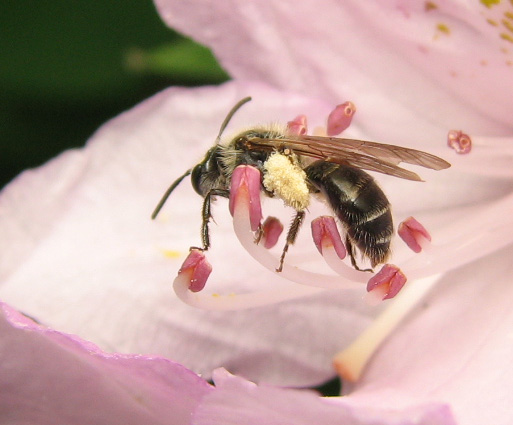
Shortly after, when azaleas bloom another set of specialists comes into service, the buzz pollinators. These are experts at shaking the pollen out of the flower stamens. One of these experts is the azalea Andrena bee. Its name needs no explanation.

So, what are honey bees doing in the meantime? They devote their time to the nectar and pollen of willows and maples. Thus, honey bees make use of these trees, but the trees themselves benefit from an abundance of native pollinators and don't need the extra help. Honey bees also gather pollen from hazelnuts. This is good for the bees but doesn't help the trees in the slightest because they are wind-pollinated.

Magnolia and mordellid beetles © Beatriz Moisset
Honey bees don't pollinate azaleas or rhododendrons. They also ignore dogwoods. As for magnolias and their close relatives, tulip trees, these plants are primarily pollinated by beetles and flies, all of them native. Honey bees are more inclined to visit generalist flowers, the ones receptive to a wide range of pollinators. Therefore, native pollinators are all that the flowers need.

Another problem with honey bees in natural areas is that they may contribute to the spread of non-native plants by pollinating them preferentially. They also may compete with native pollinators for floral resources.
Tricolored bumble bee © Beatriz Moisset
In summary, native plants and native pollinators are members of a complex community. They have adapted to each other and work well together. Honey bees, while important to agriculture, are not needed in natural areas. The only justification for keeping beehives at nature centers is to use them as a gate to the understanding and familiarization with insects and their usefulness. If the visitor leaves the nature center as ignorant of native pollinators as he was when he came in, then the center has failed to deliver the most valuable message of the bees.

It is imperative that naturalists and educators at nature centers with beehives devote time to informing the public about native pollinators and their significance to native plants. Posters with this information would also be helpful.
Augochlora pura © Beatriz Moisset

Tom Bain presents some good suggestions in his blog "GeoEcology. Earth and life through time..."

 "There is an essential piece missing from the typical presentation about pollination in many nature centers, that is the discussion of native pollinators and their essential continuing role in native and not so native ecosystems. Each presentation about honey bees should be accompanied by a hands-on activity to plant native plants that are partners to native pollinators, or the construction of simple solitary bee houses from dry bamboo canes or wood blocks. We would make progress if our children earned great take-home's like solitary bee bundles in place of coloring-in honey bee illustrations; and, planting native seeds to grow purple coneflower or other natives in place of marigolds, etc. A little effort and a subtle change in emphasis would shift attention to native pollinators."


© Beatriz Moisset. 2013

Sunday, June 16, 2013

One Bite out of Three and Wildlife


So, we all agree that we owe one third of our food to pollinators. Now let us stop thinking about us; instead let us devote a few minutes to our companions on planet Earth. Does wildlife need pollinators as much as we do? It seems that nobody has looked at this matter systematically, thus, it is not an easy question to answer. Yet, we can try.

I will try to look at the diets of some feathered and furred creatures, mammals and birds and ignore for now the scaly or slimy sorts, amphibians, fish and reptiles. I will merely list the foods that need the services of pollinators, rather than attempting to estimate percentages for lack of information in the matter. What we are trying to see is whether wildlife requires the services of pollinators. Also, I will not bore you with long lists of animals and their diets, simply limit myself to some better known examples.


Birds that come to our backyard feeders are easy to observe. They show a preference for sunflower, thistle and peanuts. Summer and winter, many birds depend on berries, from blueberries to raspberries to crabapples to holly. Of course, not all their food is insect pollinated like the ones mentioned above. Many birds feed on insects and or grass seed. You can learn more about the role of pollinators on the diets of some of the most beloved songbirds such as wood thrushes and blue birds at the North American Pollinator Protection Campaign fact sheet.


Another common wildlife of our forests and backyards is the squirrel. The eating habits of squirrels are similar to ours as a look at the way they dig through our leftovers proves. When there is no human garbage around, they go through a variety of berries, seeds and tender leaves. It would be safe to conclude that they are as indebted to pollinators as we are. The same could be said of raccoons.

One animal that symbolizes wildlife more than most is the bear. Let as take a quick look at what a bear eats through the year. When it comes out of hibernation, there isn't much plant life around, except for skunk cabbage, and skunk cabbage becomes its breakfast, lunch and dinner with some Jack-in-the-pulpit as a side dish. A bear must have a strong stomach because these plants have tiny salt crystals that would make most other animals, including us, very, very sick. I mentioned in previous posts that skunk cabbage and Jack-in-the-pulpit are both pollinated by small flies, which are the only pollinators flying around so early in the season.


Other foods become available later on. A bear will add some vegetables to a wide range of other things. When fall comes and berries ripen, it is the time to eat berries. In areas where blueberries are abundant, a bear is likely to spend long hours in blueberry fields, gorging itself. Do I need to repeat that most berries are pollinated by insects?


The many herbivores, deer, bison, skunk, rabbit, may eat mostly wind-pollinated grasses; but they also need other nutrients that can only be obtained from flowering plants, from clovers to asters.

Finally, if you are wondering, even meat-eaters benefit from pollinators, since much of their food, the herbivores, feed thanks to them.

Now, we have further reasons to be grateful to pollinators. It isn't just us, humans, who are in their debt, but practically all other animals of our fields and forests.


List of Articles 


© Beatriz Moisset. 2013