Translate

Showing posts with label mimicry. Show all posts

Sunday, July 6, 2014

The Great Impersonators, flower flies

Eristalis tenax, the drone fly, a honey bee mimic
© Beatriz Moisset

Why would one insect want to look like another? There must be some advantage in doing so. When it comes to flower flies the answer becomes apparent after a little observation.

These flies are found visiting flowers rather than garbage or dead meat like some of the flies you are most familiar with. They are rather pretty, with patterns of brown and yellow or black and yellow which easily remind you of bees. I have seen many a photographer deceived to the point of posting a picture of a flower fly claiming that it is a bee.

The goal of this remarkable imitation is not to fool photographers, of course, but rather hungry predators. Flower flies are delicious morsels of food that any bird would readily accept, but the fear of being stung by this bee mimic may lead him to think twice and skip this prey.

Some flower flies are about the size of a honey bee. The mimicry is so convincing that one of them is called the drone fly. Others are smaller and they may be imitating some of the lesser known and very abundant solitary bees. A few are long and thin and look like wasps, rather than bees.


Mallota bautias, a bumble bee mimic
© 2005 Beatriz Moisset
They can be distinguished from bees or wasps by the number of wings. Bees and wasps have four; flies have only two. The back wings have been reduced to little knobs, called halteres, used for balance. The halteres and the number of wings are hard to see when the insect is flitting about. Even when it rests on a flower, you continue to have trouble because a bee's front and back wings hook up appearing like a single unit.


Flower fly (left), bee (right)
Compare the size of the eyes
and the size and placement of the antennae
© Beatriz Moisset
Other differences are more obvious if you train your eye to see them. Flower flies have enormous eyes and tiny antennae that emerge from the front of the head, rather than higher up as in bees. Also flies are almost hairless and their legs are skinny when compared with those of bees. I hope all this helps you and saves you from embarrassing mistakes. I have seen business cards, article illustrations and even a book cover with a fly passing for a bee. So, if you still don't get them right, at least remember that you are in good company.


Toxomerus, mimics of small native bees
© Beatriz Moisset
In England, flower flies are called hover flies, an excellent description of their behavior. Some people in the US are adopting this name, so you may find either term in the growing literature on these interesting and useful insects.


A colorful flower fly
Helophilus, the sun lover
© Beatriz Moisset
These flies feed on nectar; sometimes they also eat pollen, especially the females who need this protein-rich food to produce eggs. This is why they spend so much time visiting flowers. Because of this habit they often end up carrying pollen from one blossom to another. They may not be as good pollinators as bees, but their role is not insignificant and deserves recognition. For instance, the so called drone fly is used to pollinate greenhouse sweet peppers.


Spilomyia sayi, a wasp mimic
© Beatriz Moisset
Let us applaud the bee impostors, flower flies or hover flies, for their role as pollinators.

For more on pollinators and other flower visitors read the e-book:
Beginners Guide to Pollinators and Other Flower Visitors

© Beatriz Moisset. 2014

Sunday, March 11, 2012

Zygaenidae, more little known pollinators

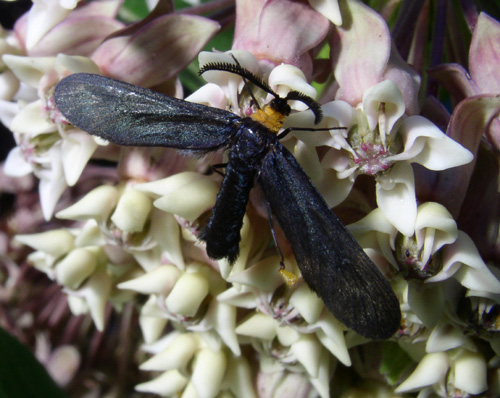
Harrisina americana (Grapeleaf Skeletonizer) on common milkweed

Another family of moths with a number of species that visit flowers is Zygaenidae. Many of them are day flying moths and, as usual, they are more colorful than night flying ones. Some are known to pollinate orchids. Their larvae feed on foliage, eating everything but the veins of leaves, so one common name for them is leaf-skeletonizers.
Acoloithus falsarius (Clemens' False Skeletonizer)

Two of them are frequently seen on milkweed flowers, the grapeleaf skeletonizer and Clemen's false skeletonizer. They are both dark blue or blue gray with a bright orange collar. The Clemen's moth is smaller than the grapeleaf skeletonizer. What is interesting about this imitative pattern is that it also mimics that of another common flower visitor, the yellow-collared scape moth. As mentioned before, the latter is toxic to predators and uses its colors to advertise its toxicity. The same thing is true of members of the Zygaenidae family. These, as well as some beetles, form part of a large mimicry complex, a fine example of Mullerian mimicry, in which they all benefit from this use of a similar warning pattern; predators need to learn their lesson only once, so more members of the guild escape attacks.
Cisseps fulvicollis (Yellow-collared Scape Moth). An unrelated moth member of the guild

Asclera ruficollis (Red-necked False Blister Beetle). A bettle member of the same mimicry guild

Another Zygaenidae that frequents flowers is the orange-patched smoky moth. Its wings are dark gray or black near the farther tip; the front half is orange. They too are members of another group of moths and also beetles with a pattern that warns predators. You can see some in a previous post: the black and yellow lichen moth and the end band net-wing lycid beetle.
Pyromorpha dimidiata (Orange-patched Smoky Moth)

Moths as Pollinators
List of articles
Beginners Guide to Pollinators and Other Flower Visitors

© Beatriz Moisset. 2012

Friday, December 2, 2011

Black-and-yellow lichen moth, a little known pollinator

We are very familiar with the pollinating role of butterflies and we are aware that a number of moths, such as the hummingbird moth also visit flowers frequently and provide pollinating services. But we seldom pay attention to the countless other flower-visiting moths and their roles as pollinators.
Lycomorpha pholus (Black-and-yellow Lichen Moth), a very likely pollinator

The black-and-yellow lichen moth is a very attractive, rather slender moth often seen visiting goldenrods and some other flat, open flowers. It is widely distributed throughout the continent, from Canada to Texas and Mexico. Adults fly from June to September. The larva may take longer than a year to complete its development.

Its wings are black and yellow or black and orange as its name indicates. The body and legs are black or blue-black. The caterpillar of this moth and a number of its relatives feed on lichens; that is what the other part of the name refers to. It resembles the lichens it feeds on in color and appearance; a convenient disguise that hides it from predators.

The adult performs another interesting trick of mimicry. It bears an astonishing resemblance to some beetles, called net-winged beetles, especially the end band net-wing or Calopteron terminale. These beetles are poisonous and are avoided by hungry birds. The contrasting colors serve as advertisement of their bad taste. The black-and-yellow lichen moth is also poisonous and so is the orange-patched smoky moth, another one with a similar pattern. The resemblance seems to be beneficial to all of them. Birds need to learn only one kind of warning signal to avoid all these unrelated species and so more beetles and moths survive than if they exhibited different alarm signals. This is called Mullerian mimicry in honor of Muller, the first one to describe and explain this phenomenon.
Calopteron terminale (End Band Net-wing), a poisonous lycid beetle

Orange-patched Smoky Moth, a member of the mimicry complex

Little is known about the black-and-yellow lichen moth's role as a pollinator; but given its flower-visiting habits it is almost certain that it performs this function. This is just another example of how much we need to learn about moths and their role in the ecosystems. If anybody reading this knows of some information on the subject, please, point me in the right direction. We all need to learn more about this and many other moths' capacity as pollinators.

Another view of the black-and-yellow Lichen Moth


See: Bugguide.net
Moths as Pollinators
List of articles
Beginners Guide to Pollinators and Other Flower Visitors

© Beatriz Moisset. 2012