Translate

Showing posts with label beetle. Show all posts

Monday, September 26, 2016

Ecosystem Engineers and the Web of Life

Goldenrod in bloom
© Beatriz Moisset

Goldenrod bunch gall
© Beatriz Moisset

This time of the year, fields and meadows are usually covered by a plethora goldenrods particularly the tall variety, known as Solidago altissima. Goldenrods nurture a huge variety of small creatures. Some feast on the rich pollen and nectar of their flowers. Others find ways to feed on the not so nutritious leaves and stems. The plants are so abundant and vigorous that they survive quite well the onslaught of all these feeders.

Rhopalomyia solidaginis
(Goldenrod bunch gall midge)
© Beatriz Moisset

Rhopalomyia solidaginis
Larva inside gall
© Beatriz Moisset

The goldenrod bunch gall midge is one of a number of goldenrod feeders that have developed interesting techniques to feed and stay safe from predators at the same time. The larva of this midge injects special substances into the tips of the goldenrod stems. These substances stimulate an unusual vigorous sprouting of the growing stem and leaves. A tight bunch or cluster of leaves with a nutritious, tender center develops. These clusters can be quite numerous in a field of goldenrods. They are easy to spot and they are known by the name of bunch galls. They provide both nourishment and shelter to the insect.

Parasitic wasps, Platygaster sp
© Beatriz Moisset
This story doesn't end there. The midge creates conditions favorable to other small creatures when it builds the bunch gall. Tiny beetles and wasps find a nice place to hide and even raise their families in the bunches of leaves. Curiously, the galls go beyond that. When dead, they become compost and enrich the soil in a larger scale than goldenrod plants free from galls.
Microrhopala vittata (Goldenrod Leaf Miner)
Inside bunch gall
© Beatriz Moisset
Microrhopala vittata (Goldenrod Leaf Miner)
© Beatriz Moisset
This is reminiscent of what beavers do. These animals build dams which provide habitat for fish and frogs and other animals. This have earned them the name of ecosystem engineers. The goldenrod gall midge is also an ecosystem engineer, although in smaller scale. It is surprising how such an insignificant and easily ignored tiny insect can contribute to the web of life.


Further Readings


Wednesday, March 18, 2015

Mass Appeal and Pollination


Some of the many visitors to goldenrod.  © Beatriz Moisset

Many flowers are not particularly selective; they welcome all kinds of visitors. They are wide open, easily accessible, thus many insects can reach the nectar and/or pollen regardless of whether their tongues are long or short. Such flowers provide a convenient standing platform to save their visitors the inconvenience of hovering over them. Their structure is simple so the pollinators don’t need to figure out how to open them in order to reach their rewards. Goldenrod is a fine example.
Monarch butterfly on goldenrod. © Beatriz Moisset
 I have spent countless happy hours observing goldenrods and photographing their numerous visitors. The one most common in my area is the Canada goldenrod. Several hundreds of species visit their flowers. Bear in mind that not all flower visitors qualify as pollinators. Some are not efficient at carrying pollen, or sit in one place for a long time and never make it to another plant. Such is the case of ambush bugs, whose only concern is to snare hapless pollinators to make a meal out of them. If you are interested on photographing and identifying pollinators this is a good place to start.

Metallic green bee. © Beatriz Moisset
 This plant blooms in the fall. It often gets blamed for allergies, but the real culprit is another plant that grows close by, sometimes intermingled with goldenrods, ragweed. Its flowers are inconspicuous because its pollen gets carried by the wind, not by officious pollinators. This is how it gets into our nostrils and causes our suffering. The much maligned goldenrods have larger, heavier and stickier grains of pollen that cannot get airborne and that require help from visitors.

Two states, Kentucky and Nebraska, have the goldenrod as their state flower. It is not clear which species of goldenrod Kentucky picked, but it is likely the Canada goldenrod (Solidago altissima). Nebraska’s choice is clearer, the giant goldenrod (Solidago gigantea). South Carolina, not satisfied with a state flower, also has a state wildflower. It is the Canada goldenrod. It is worth mentioning that Delaware has a state herb, the anise-scented or sweet goldenrod (Solidago odora).

Bumble bee on sunflower. © Beatriz Moisset

Coreopsis. © Beatriz Moisset
 Two other state flowers also have mass appeal. Like goldenrod, they are members of the daisy or aster family, easy to access by different kinds of visitors. They are Kansas’ sunflower (Helianthus annuus) and Maryland’s Black-eyed Susan (Rudbeckia hirta). It is worth mentioning here that two states, Florida and Mississippi, chose the tickseed (Coreopsis spp.) as a state wildflower in addition to their official state flowers, the orange blossom and the magnolia, respectively.

Kentucky: Goldenrod
Nebraska: Goldenrod
South Carolina (wildflower): Goldenrod
Delaware (herb): Goldenrod
Kansas: Sunflower
Maryland: Black-eyed Susan
Florida (wildflower): Coreopsis
Mississippi (wildflower): Coreopsis

The indiscriminate pollination strategy represented by all these flowers has advantages and also disadvantages. They suffer no shortage of pollinators. If one species is doing poorly one year, as it often happens in the insect world, there are plenty more to fill in the deficiency. However, sometimes too much of a good thing can be bad. Some of these non-specialized pollinators may be visiting a variety of flowers instead of being faithful to just one species so they end up carrying the wrong kind of pollen in such cases.

Blossoms with such mass appeal give me the opportunity to introduce the reader to the main groups of pollinators. They are all well represented on these mass appeal flowers.

Andrenidae bee © Beatriz Moisset
Bumble bee. © Beatriz Moisset
 Let us start by getting acquainted with bees. More than 80 species have been seen on goldenrods. Some of them deserve mention. Bumble bees are larger than other bees, plump, dark with yellow or white stripes, and hairy. Metallic green bees are small and gorgeously colored. They may escape notice if one isn’t very observant; but it is easy to become captivated by their shiny aspect. Mason bees and leaf-cutting bees carry pollen on their underbelly, unlike most other bees that carry it on their hind legs. Most of them are dark, nearly black and about the size of honey bees or slightly smaller.

Wasp. © Beatriz Moisset
 Wasps are related to bees and sometimes people confuse them. Most wasps are less hairy than bees and have narrow waists. They raise their young on a diet of insects or spiders, instead of pollen and nectar as bees do. Adult wasps need nectar to fuel their flight. Thus, they are frequent flower visitors and accomplish some pollination.

Syrphid fly. © Beatriz Moisset

Many types of flies, including mosquitoes and gnats visit flowers to feed on their nectar. Some are good pollinators. The Syrphid flies, also called flower flies, are among the most assiduous flower visitors. Most of them mimic bees or wasps and are frequently mistaken for them. However, they don’t sting and there is no reason to fear them.

Buckeye butterfly on goldenrod. © Beatriz Moisset
Pyrausta moth on sunflower. © Beatriz Moisset
Yellow collared scape moth on goldenrod. © Beatriz Moisset
 Butterflies, skippers and moths have extremely long tongues that they can use like drinking straws when sipping nectar. They favor long necked flowers and carry pollen from one to another.

Polished lady beetle on sunflower. © Beatriz Moisset
Soldier beetle on goldenrod. © Beatriz Moisset
Finally, beetles, although not well specialized for pollination, are also capable of doing so in special circumstances. We already mentioned magnolia pollination by beetles. They also visit other flowers and can do a reasonably good job in some cases.

In the following chapters we’ll see flowers that have chosen a different strategy. They are pickier or more selective. Some attract a handful of visitors; a few go to the extreme of having relationships with only one species of pollinators.

References

Tuesday, July 22, 2014

Flower Longhorn Beetles, the Elegant Crowd


Strangalia luteicornis on buttonbush
© Beatriz Moisset
 Most beetles we are familiar with are roundish or oval-shaped hard shelled insects. Think ladybugs or Japanese beetles. Others are a little longer and cigar-shaped. An entire group of beetles distinguishes itself for its elegant streamlined figure; these are the so called flower longhorns. The name refers to their love of flowers as a hangout and to their long antennae. No, they don't have real horns, just antennae like other insects. Sometimes these organs can be longer than their entire body.

Strangalia famelica, the hungry strangalia
© Beatriz Moisset
Flower longhorns are the fashion models of the beetle world. Their slender and highly stylized outline is reminiscent of that of wasps; although they would never be mistaken by such because they have the characteristic hard shell (elytra) of all beetles covering their membranous wings. In their elegance they would make a nice fashion parade. Some carry their slenderness to the extreme of appearing anorexic. In fact one of them was given the scientific name of famelica, which means starved one in Latin. By contrast, the banded longhorn (Typocerus) and Brachyleptura appear almost obese, although they are still rather slender when compared to most beetles.

Brachyleptura rubrica covered with pollen
© Beatriz Moisset

The banded longhorn, Typocerus velutinus on milkweed
© Beatriz Moisset
Flower longhorns love flat open blossoms of the umbrella type, such as the members of the carrot family. They also like flowers of the rose and aster family as well as wild hydrangea. They feed on their pollen. Sometimes you find several different types amiably mingling together on these flowers. They are regarded as lesser pollinators of such plants. It is not surprising, when you see some of them coated with pollen.


A couple of Metacmaeops vittata on wild hydrangea
© Beatriz Moisset
Their larvae don't have such wholesome habits. They are wood borers, meaning that they feed on wood. However none has been reported as a serious pest of trees. Perhaps trees have enough defenses against them or there are enough enemies to keep their numbers from getting out of control.

Analeptura lineola on wild hydrangea, with pollen on its back
© Beatriz Moisse
Flower longhorn beetles are a beautiful addition to the biodiversity of forests, well integrated with the remaining members of the community.

For more on pollinators and other flower visitors read the e-book:
Beginners Guide to Pollinators and Other Flower Visitors

© Beatriz Moisset. 2014

Sunday, January 12, 2014

Beginners Guide to Pollinators


Read the review by Kathy Keatley Garvey at the Bug Squad website, For Beginners, a Guide to Pollinators
So many flowers.  So many pollinators. So many floral visitors.
On every field trip, we see something new and different.
With so much interest in pollinators, it's good to see that biologist Beatriz Moisset has written a downloadable book, "A Beginners Guide to Pollinators and other Flower Visitors." It's meant for young adults and beginners.


Beginners Guide to Pollinators and other Flower Visitors available at:

Friday, May 24, 2013

One Bite out of Three


Megachilid or mason bee, often used to pollinate fruit trees.
© Beatriz Moisset

We frequently hear that "one bite out of three comes to you courtesy of pollinators." Other times we hear it expressed as "one bite out of three comes to you courtesy of bees," implying that the bees in question are honey bees. Where did these statements originate? How well documented are they? It all sounds plausible but I hesitate to cite numbers without certainty when I give presentations about pollinators.

Fortunately a group at the University of California at Berkeley decided to get to the bottom of it. I am happy to tell you that they found the first statement to be fundamentally accurate.

Claire Kremen, one of the coauthors of the study and member of the Committee on Status of Pollinators, summarizes the results of their 2006 study as follows: "Out of the 115 crops studied, 87 depend to some degree upon animal pollination, accounting for one-third of crop production globally."

Now, I can relax and go on telling my audiences that pollinators are responsible for one third of our food. I can also face the second claim, "one bite out of three comes to you courtesy of bees." This claim originates from the confusion between pollinators, bees in general and honey bees, and it is not accurate. Some information is in order.

Augochlora pura bees.
© Beatriz Moisset
Honey bees are the most important pollinators of agricultural crops. They excel at pollinating a number of fruit trees such as apples, pears, peaches and almonds. But they are not alone in this task. We owe a lot to all the other carriers of pollen, 20,000 species of bees (4,000 in North America alone) and an assortment of wasps, moths, flies and even bats.
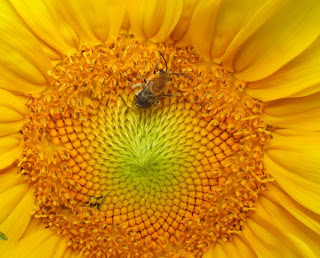
Anthophorini bee. It pollinates several crops.
© Beatriz Moisset
Let us look at crops pollinated mostly or entirely by non-honey-bee pollinators. Alfalfa is the most important one that comes to mind. No, we don't eat alfalfa but cows, sheep, goats and even chickens do. Without alfalfa these animals would be severely malnourished; they may not even survive. Most alfalfa growers use the services of bumble bees, alkali bees and alfalfa bees or a combination of the above plus a few other bees. These insects are well adapted to the structure of alfalfa flowers and handle them efficiently. Honey bees, on the other hand, are not fond of these blossoms and do a poor job. It may take several honey bees to do the job of one alfalfa bee; but they make up in numbers what they lack in finesse. This is why they are used in large alfalfa fields where there is no habitat left for other bees, particularly in California.

When New Zealand ranchers started raising cattle, they also needed to grow clover for cattle feed. They had to purchase seed from abroad every year because the plants failed to set seed for lack of pollinators. European bumble bees were imported to do the job, and in fact they promptly took care of the problem. Notice that it was bumble bees rather than honey bees which were counted for this mission.
Bumble bee buzz-pollinating azalea. © Beatriz Moisset
See video
The flowers of tomatoes, eggplants, peppers and other members of the potato family require special handling by the pollinator, a process called buzz pollination. Bumble bees and other native bees do this efficiently. Honey bees cannot, do not perform this maneuver. For a brief explanation of buzz pollination see: Buzz Pollination by Sue Rosenthal.

Blueberries and cranberries are mostly buzz pollinated. Unfortunately, large fields of these crops provide no habitat for the native bees and bumble bees which are most adept at this task. Under these circumstances, honey bees are used as pollinators despite their poor performance.
Yucca moth, a highly specialized pollinator. © Beatriz Moisset

Figs are pollinated by fig wasps, yucca by yucca moths, and mangoes by bats. A few other specialty crops use the services of specialized insects. Several species of flies are used to pollinate some crops such as onions and cabbage. Honey bees, or even other bees are not involved here, either.

In summary, we must remember to give credit to all pollinators. Let us thank them all. My favorite one is not a honey bee, not even a bee. It is the little fly, or midge, that pollinates the cacao flowers. What would the world be without chocolate?

Importance of pollinators in changing landscapes for world crops

List of Articles 
Also, see Bees and Vitamins. The importance of pollinators goes beyond the "one bite out of three" to our basic nutrition needs.
Update to pollinators and vitamins: Contribution of Nutrients by Pollinators
One Bite out of Three and Wildlife
One Bite out of Three before Columbus

Beginners Guide to Pollinators and Other Flower Visitor

© Beatriz Moisset. 2013
 

Monday, September 3, 2012

Cast of Characters

Every year flowers bloom in succession and, with them, a predictable cast of characters shows up routinely. Three plants, in particular, call your attention for the numerous repeat patrons to these restaurants and their nectar: common milkweed, mountain mint and goldenrod. Or you may regard the visitors as actors hired to play roles in these theaters. The truth is that every year the theaters have to hire the descendants of previous visitors. The original ones are long gone. Here are some of the representatives of the mountain mint crowd, each photo accompanied by a great-grandchild or great-great-grandchild repeating their roles:

Great golden digger wasp and grandchild (2004 and 2006)


Red banded hair streak butterfly and great- great- great-... well, let us say that at least six generations have elapsed between one and the other (2006 and 2012). It looks like both pictures were taken the same day.


Macrosiagon limbata wedge shaped beetle and his great-granddaughter (2004 and 2007)


Not a very nice fellow. It lays its eggs on the flowers and the little larvae hitches a ride from a passing bee. Then they feed on the bee's stored food and on the bee baby. The adults are so short lived that you don't see them visiting earlier or later blooming flowers.

The wasp and the butterfly also play in many other theaters through the seasons. The beetle, on the other hand, is most often seen on this plant.

Beginners Guide to Pollinators and Other Flower Visitors

© Beatriz Moisset. 2012

Monday, June 13, 2011

Magnolias and Beetle Pollination


Magnolias were among the earliest flowering plants, which evolved many million years ago, long before there were any bees. Butterflies and moths were also absent in those days. The only pollinators available were probably beetles and flies, the so-called “dumb pollinators”. This term refers to the fact that the late-comers to the world of pollination, particularly bees, can perform remarkable feats of memory and skillful manipulation of flowers.

When bees entered the scene, perhaps twenty or thirty million years later (give or take a handful of millions), they took to the pollinating job with gusto. They became real pros which adapted to the ever growing variety of flowers and developed skills par with the complexity of these newly evolved plants. The same can be said of many butterflies and moths and also some wasps. That is how they earned the name of "smart pollinators".

Neither magnolias nor beetles are very specialized to pollination by insects. The flowers, though lovely have a very simple structure; for instance, there is no distinction between petals and sepals as in most other flowers. In turn their pollinators, beetles, are very clumsy at their task; sometimes they get carried away and eat parts of the flowers along with the pollen they find there. Their mouth parts are made for chewing, rather than for gathering nectar and pollen, so they can’t be blamed for their sloppiness. The flowers, in turn, are adapted to this rough treatment; that is why magnolia petals tend to be rather leathery; and, most importantly, the seeds are well protected.


You develop a new respect for the pollinating responsibility of beetles when you take a look at the many families of these insects that visit magnolia flowers: sap-feeding beetles, tumbling flower beetles, leaf beetles and weevils, among others (or if you prefer their technical names: Nitidulidae, Mordellidae, Chrysomelidae and Curculionidae).


Bees, bumblebees, flower flies, a few types of stink bugs, leafhoppers and several other types of insects are also found visiting magnolia flowers attracted by their nutritious pollen and nectar.

But most of them arrive at the flowers too late, after the blooms are past their prime and are not receptive for pollination. So it is the beetles that carry the lion's share of the responsibility for perpetuating these plants.


List of articles

© Beatriz Moisset. 2012