Translate

Thursday, April 4, 2013

What is the Connection Between Honey Bees and Almond Farming?


Honey bee. © Beatriz Moisset

These days we hear a lot about Colony Collapse Disorder (CCD) and other problems that plague bees and cause their numbers to plummet. We also hear about the concern for crops, that of almonds in California, in particular. Every year millions of bee hives are shipped to California to provide pollination for almonds during the brief period of their bloom. Beekeepers know that transporting bees and making them pollinate a monoculture such as almonds are stressful to them.

Statistics about the declining numbers of bee hives are confusing, at least to me. Some vary widely but they all indicate that numbers are down and continue to drop. What I find confusing is that you frequently hear about repeated annual losses of 50% or so. This would mean that, in a few years, bee populations would bee reduced to insignificant numbers. But this is not exactly what is happening. The situation is bad, but not extreme. This USDA graph published by Yale Scientific Magazine may help clarify things. Bear in mind that statistics refer only to honey-producing hives, not to hives used for crop pollination. There has been a decline of about 50% in the last 50 years, the most dramatic drop took place in the 1980s, when parasitic mites arrived in the US. Unfortunately, the graph doesn't cover recent years, though.

Even more puzzling is that, although the numbers of bees have been dropping, the acreage of almond cultivation has been growing dramatically in recent years. CCD or not, almond crops continue to be pollinated by honey bees.

According to the Food and Agriculture Organization of the United Nations the area covered with almond trees in the United States in 1969 was 151,000 acres (62,000 hectares). Recent statistics by the USDA (2012 California Almond Forecast) show a steady growth of acreage dedicated to almond trees in California, from 418,000 acres (169,000 hectares) in 1995 to an estimated 780,000 acres (316,000 hectares) in 2012. In summary, almond cultivation in California has grown about 500% in the past 40 years.

Spring in the Orchard
Note the bare ground under the trees, sign of herbicide use  © Kelsey J Nelson. 2010 Flickr

My questions are: how do diminishing populations of honey bees manage to pollinate increasing numbers of almond trees? Does transporting bees annually have something to do with this pollinator's difficulties? We know that this is stressful to the insects. We also know that the convergence of so many hives from so many areas of the country into one point is conducive to the spread of pathogens. So, perhaps, this practice is contributing to the problems that bees face.

I have no answers, but hope that somebody out there does.

© Beatriz Moisset

Monday, March 4, 2013

Pollinators of the American Chestnut


American Chestnut Pollen Stalks: Photo by Timothy Van Vliet
 "And the blossoms gave up one of the best honey crops we ever had." said Noel Moore of Rabun County, Georgia, in 1980 when asked about his memories of the American chestnut. He added mournfully: "We've never had a honey crop like we did since the chestnuts died, because there's not that much nectar in the wild now. Whenever chestnuts bloomed, in the morning, early, the trees looked like just the whole tops were alive with honeybees working on getting the nectar."

The American chestnut, Castanea dentata, became virtually extinct as a species, almost entirely gone from the Eastern United States by the 1950s. Before that time it had represented 25% to 30% of the forest canopy from Maine to Georgia. An infestation arrived from Asia, probably introduced with Asian chestnut trees brought by horticulturists. A fungus, first noticed in 1904, but probably already present in several areas of this country, had become a killer of native chestnut trees.

The Asian chestnut species has coexisted with the fungus for millions of years and has developed ways to withstand its attacks; but the American chestnut is helpless. To make things worse, the fungus spores travel easily through air and show great resistance to weather changes. So, what came to be known as the American chestnut blight spread through the entire range of this species killing nearly all the trees in less than half a century.

Many species that depended on the nuts for food, from chipmunks to bears, experienced significant losses. In fact, populations of squirrels and wild turkeys crashed. Squirrels bounced back on their own, but turkeys needed human assistance. The effect traveled up the food chain. Goshawks and other predators felt the impact. Gone with the chestnut trees, although less noticed by most, were some insects that fed on this tree; probably seven species of moths became extinct.

Humans also suffered the loss grievously. Not only the nuts but the timber were valued and now they were gone. Dedicated scientists and agronomists of the Department of Agriculture fought for years to slow down or stop the march of the parasitic fungus, resorting to a variety of methods to heal the trees or to introduce pests that weakened the fungus. All were futile.

What happened to the pollinators of this species? Pollination research was almost non-existent when the trees were abundant and now that they are almost gone nobody is gathering such information. That is why I was glad to read the observations of one old enough to remember what things were like when the tree was still alive. His comments show that non-native honey bees visited the flowers in huge numbers. But, what about the native pollinators, the ones that had lived for thousands of years with the tree and its flowers?

For lack of American chestnut trees, we can use proxies, the closest relatives of the deceased, to gather some indirect information on their pollination . The flowers of species of chestnuts are strongly scented and attract numerous insect visitors, not just honey bees, but also many species of solitary bees, butterflies, flower flies, and beetles. Specialist honey producers sell a monofloral honey made from blossoms of the European chestnut, Castanea sativa. It is strong tasting and darker than other honeys. Chinese chestnut trees, Castanea mollissima, grow in some gardens and parks where I regularly go for walks. The scent of their flowers is almost overpowering in the months of May and June.  

We can assume that American chestnuts were also visited by many insects and that they were pollinated by them. They too must have suffered from the near disappearance of the species. Some of them may have been able to adapt and resort to pollen and nectar from other plants although no other trees bloom as heavily as chestnuts in late spring and early summer. The American chestnut disappearance must have been a severe blow to all of them. Perhaps some of them, too, went nearly or totally extinct. Probably we'll never know.

The struggle to bring the chestnut back from its near extinction continues. Horticulturists are resorting to a variety of approaches, from controlling the virulence of the fungus to breeding new varieties of the tree in an attempt to restore the American chestnut to its native geographic range. Some strategies look more promising than others. All require enormous effort. Let us hope that they succeed.

Thursday, November 1, 2012

Monarchs and their Enemies


Male monarch butterfly. © Beatriz Moisset

We are told that monarch butterflies are well protected against predators and indeed they are. Their caterpillars feed on milkweeds, rich on highly toxic substances known as cardenolides. Having developed resistance against these chemicals, the monarchs themselves are poisonous so predators avoid them. A young, inexperienced bird that takes a bite off of a caterpillar or a butterfly spits it out in disgust and may be sick afterwards. It learns its lesson after no more than one trial.

Are monarchs completely free from enemies, then? Not so, there are exceptions. A number of predators and parasites have also become tolerant or immune to the cardenolides. Thus, they can feed on monarchs with relative impunity. The list of predators includes birds, mice and insects. Monarchs can also become victims of certain pathogens.

Robin. © Beatriz Moisset
Brown thrashers, grackles, robins, cardinals, sparrows, scrub jays and pinyon jays are known to feed on monarchs. Some of these birds avoid the body parts with higher concentrations of cardenolides by eating only the abdomens or by eating this kind of food in moderation. When monarchs arrive in their wintering grounds in Mexico they are plump with stored fats that will keep them through the winter. A whole new set of predators is eagerly awaiting them. Mice feast mostly on dead and dying butterflies that have fallen to the ground. Several species of birds, especially black-backed orioles and black-headed grosbeaks take a heavy toll on the millions of wintering butterflies. A few months after their arrival in Mexico, the monarchs may have lost a fair amount of toxins, making them more appetizing. It is estimated that between 7 and 40% of them fall victims to predation in their roosting grounds.

Small milkweed bug. © Beatriz Moisset

Invertebrates may be worse than mice and birds at decimating the populations of monarchs. Eggs, caterpillars and pupae are all vulnerable. The small milkweed bug doesn't just eat milkweed. It becomes carnivorous in occasions and catches milkweed caterpillars.

Spined soldier bug. Podisus maculiventris. © Beatriz Moisset
The spined soldier bug is an indiscriminate predator of many species and is not averse to feeding on monarchs. It impales caterpillars larger than itself and feeds on the internal fluids. (View of a spined soldier bug feeding on a monarch caterpillar).

Polistes paper wasp. © Beatriz Moisset

Paper wasps, Polistes, sometimes attack monarch caterpillars or pupae to feed their young. Recent reports suggest that this form of predation is more common than originally thought. (View of several paper wasps collecting food from a monarch chrysalis).

Asian lady beetle or ladybug. © Beatriz Moisset

In addition to all these native predators, the introduced Asian lady beetle is becoming a serious enemy of monarch eggs and caterpillars.

Tachinid fly. © Beatriz Moisset

Several tachinid flies and parasitic wasps lay their eggs on the monarch caterpillars for their larvae to feed on. All these insect predators and parasites probably consume a substantial number of monarchs before they even reach maturity.


Parasitic wasp, Pteromalid. © Beatriz Moisset

You may feel sorry for the monarchs; but this is the way of nature. Everything is interconnected and monarchs are not the exception. Sad as it seems, these butterflies serve a purpose by being part of the food chain. They produce enough eggs to survive and prosper despite the attacks. They could go on for thousands of years as they have already done, feeding on milkweeds and providing food for other forms of wildlife. The biggest threat to them does not come from those that feed on them but from the changes we are introducing in the planet.

Another frequent enemy of monarch caterpillars is a predatory stink bug, Stiretrus anchorago (Anchor stink bug).

Further readings:
Parasites Affecting Monarchs. University of Georgia
Parasites and Natural Enemies. University of Minnesota
A Butterfly's Flashy Colors.


List of articles

© Beatriz Moisset. 2012

Tuesday, October 16, 2012

Ants, the Unlikely Pollinators

© Beatriz Moisset

Ants are seen visiting flowers with great frequency. People often ask me: Do ants pollinate? I answer with another question: What do you think? Are ants capable of pollinating flowers? Do they have what it takes to carry pollen from one flower to another, preferably of another plant?

Ants stealing nectar from the spur of a jewelweed. © Beatriz Moisset
Most pollinators can fly from plant to plant. Ants, lacking wings, don't go very far. Moreover, ants may be coated in some sort of antibiotics which may be detrimental to pollen. In some cases ants steal nectar from flowers, causing damage and reducing the likelihood of later pollinators' visits. Some plants resort to extrafloral nectaries, nectar-producing glands located in other plant parts, to keep the ants and other nectar robbers away from the valuable treasure reserved for legitimate pollinators.

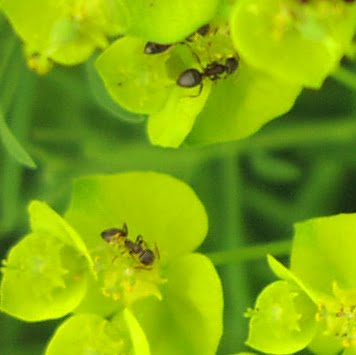
Ants pollinating wood spurge. © Beatriz Moisset
Despite all these drawbacks, there are instances in which ants are pollinators. One case is that of spurge, or Euphorbia. This plant grows very low near the ground and tends to intertwine its runners with those of nearby plants. This increases the chances of ants going from the flowers of one plant to those of another without the need to fly. Perhaps the pollen of spurge is more resistant to the chemicals on an ant's body. So, ants pollinate spurge; although, there are also small bees that perform this job just as well.

A few other plants, also low-growing, are pollinated by ants. Finally, there are some interesting cases of orchids pollinated by ants in Australia in a highly specialized way. So, yes, ants join the ranks of pollinators. They may even be the pollinators of choice for some plants in harsh, dry climates.

Ant on Queen-Anne-lace. © Beatriz Moisset

List of articles


© Beatriz Moisset. 2012 

Monday, September 3, 2012

Cast of Characters

Every year flowers bloom in succession and, with them, a predictable cast of characters shows up routinely. Three plants, in particular, call your attention for the numerous repeat patrons to these restaurants and their nectar: common milkweed, mountain mint and goldenrod. Or you may regard the visitors as actors hired to play roles in these theaters. The truth is that every year the theaters have to hire the descendants of previous visitors. The original ones are long gone. Here are some of the representatives of the mountain mint crowd, each photo accompanied by a great-grandchild or great-great-grandchild repeating their roles:

Great golden digger wasp and grandchild (2004 and 2006)


Red banded hair streak butterfly and great- great- great-... well, let us say that at least six generations have elapsed between one and the other (2006 and 2012). It looks like both pictures were taken the same day.


Macrosiagon limbata wedge shaped beetle and his great-granddaughter (2004 and 2007)


Not a very nice fellow. It lays its eggs on the flowers and the little larvae hitches a ride from a passing bee. Then they feed on the bee's stored food and on the bee baby. The adults are so short lived that you don't see them visiting earlier or later blooming flowers.

The wasp and the butterfly also play in many other theaters through the seasons. The beetle, on the other hand, is most often seen on this plant.

Beginners Guide to Pollinators and Other Flower Visitors

© Beatriz Moisset. 2012

Wednesday, May 30, 2012

Gardening for Honorary Butterflies (Mint Moths)


Not all moths fly at night and not all are drab. Some deserve the name of honorary butterflies. In fact sometimes they are mistaken for them. Sorry I tricked you by using the word butterflies in the title (not really); but I was afraid that most would ignore this article if they just saw the word moths. The fact is that there are ten times more species of moths than of butterflies; that they are very important components of ecosystems and worth welcoming in our gardens. Some are very beautiful and can give visual enjoyment to the gardener. To me, most if not all are beautiful each in its own way. But I know people who dislike, fear or hate moths in general. I hope that at least they take time to look and learn to love the pretty ones.

I will save some of the most striking ones, such as hummingbird, imperial and Luna moths for later. I will start with some that many people are unaware of and amazed when they first see them.

The crambid snout moths represent a family (Crambidae) with more than 850 species in North America. They get their common name from the appendage that sticks out on front of their heads. Some of them, the members of the genus Pyrausta feed on plants of the mint family, so I will be calling them mint moths, although they don't really have a common name. Most of them are brightly colored and are seen during the day.
Pyrausta orphisalis (Orange Mint Moth) on mountain mint
©Beatriz Moisset


The larvae of the orange mint moth (Pyrausta orphisalis) feed on a variety of mints and sometimes you cans see signs of their feeding, especially at the buds and newer leaves. But the damage is not known to reach serious proportions. It is good to remember that caterpillars are bird food. So it is a good idea to have a few well behaved caterpillars such as these ones to attract birds to the garden. It is also a pleasure to spot this very attractive moth resting on a plant of mint.

Pyrausta signatalis (Raspberry Pyrausta) on mint
©Beatriz Moisset


The raspberry mint pyrausta (Pyrausta signatalis) is also richly colored and earns its name because of the raspberry color of its wings. The larvae feed primarily on spotted beebalm (a member of the mint family), they also feed on a few related plants such as wild bergamot and scarlet beebalm.

Pyrausta tyralis
  © Bob in swamp Flickr
 Another member of this genus, even more striking in its coloration is the Coffee-loving pyrausta (Pyrausta tyralis). This one breaks the mold with its feeding habits, a peculiar feat. It gets its name because it likes wild coffee (Psychotria nervosa) found in Florida. It also feeds on some Asteraceae such as dahlia and bidens.

It is worth mentioning that there are many species of mint moths in Europe. Here is a gorgeous one: the golden mint moth (Pyrausta aurata).

Pyrausta aurata © Bramblejungle Flickr

In summary, if you want to attract these honorary butterflies to your garden plant a variety of mints including beebalm which by the way is also good at attracting hummingbird moths and hummingbirds.

Moth as Pollinators
List of articles
Beginners Guide to Pollinators and Other Flower Visitors

© Beatriz Moisset. 2012 

Tuesday, May 1, 2012

Pollinator Conservation Short Course


Snyder Farm

On April 27, I attended a short course on pollinator conservation at the Snyder Farm, an agricultural research station of Rutgers University, located in Pittstown, NJ. It was sponsored by Rutgers University, the Xerces Society for Invertebrate Conservation and the Natural Resources Conservation Service (NRCS). There were very informative sessions in the morning and a walk of the property in the afternoon ending with information on the current Farm Bill provisions for pollinator conservation.

We learned about recent research about the most common native pollinators of crops in New Jersey, several bumble bees and sweat bees among others. This is probably applicable to most of the Mid Atlantic region. We were informed about recent studies on the best native plants for pollinator gardens adjunct to farms. Among them some very familiar ones such as: cutleaf coneflower, some types of goldenrods, butterfly and swamp milkweeds, Joe pye weed and New England aster.
One of the best ecosystem-service providers, Bombus impatiens, on one of the best plants for pollinators, New England aster

There were presentations on how to protect pollinator habitats: bare spots in the ground, logs or old trees and plants with hollow twigs; all of them provide nesting places. Perhaps most important is the use of Integrated Pest Management, to reduce pesticides to the bare minimum and to use them only very early or very late in the day, when pollinators are less likely to be active. See: Attracting native Pollinators, Pollinator Friendly Planting Guide.
Canola fields

During the walk we visited the fields of rapeseed or canola, which are captivating with their incredibly bright yellow flowers at this time of the year. Sadly for us the wind was so strong, sharp and continuous that flower visitors were notoriously absent that day.  The pollinator garden was at an incipient stage. Its value will increase with time. We were shown how to do an assessment of native bee conservation practices; for instance, the presence of a windbreak, hedgerows between fields or along the edges of the property, presence of nest sites and natural vegetation within certain distances, etc. This assessment is used later on to evaluate any improvement.
Pollinator garden

What was completely disconcerting to me was the huge expanse of lawn near the farmhouse and between orchard fields. It would have been more acceptable if the lawn was heavily sprinkled by "grass companions", broad leaved weeds which can provide food for many sorts of pollinators. I didn't see any broad leaved plants worth mentioning. To make sure I was seeing right, I got on my hands and knees and only saw some solitary gill-of-the-ground and the occasional violet. I have seen many suburban lawns that are friendlier to pollinators without really trying.
A wasted opportunity, huge pollinator unfriendly lawn

 Perplexed, I asked Tim Dunne, the NRCS representative, about it. He agreed that such lawn was not exactly pollinator heaven. He has tried to change such practice without success. The farmer in charge of planting and maintenance emphatically refuses to have weeds which, according to him, would promptly invade the orchards. By looking at that lawn, I am sure that they are using herbicides, a practice that makes no sense at all when you are trying to create a pollinator habitat. The few square yards of pollinator garden look puny by comparison with the several acres of pollinator unfriendly lawn I saw that day.
Bluets, one of many lawn companions good for pollinators
Another good lawn companion, low growing aster

It is time that somebody comes up with good seed mixes for pollinator lawns. Sam Droege of the USGS said it very eloquently in 2009 in an e-mail to the Bee Monitoring group.
"What if someone would develop a bee lawn seed mix? 
Wouldn't that potentially have a higher impact on the number and kinds of bees in urban areas than the high effort, high cost, high maintenance (but, yes, very pretty) pollinator garden?"

These mixtures should include lawn companions beneficial to pollinators, non-invasive and reasonably easy to maintain. Meeting these requirements should be easier in a farm than in a suburban garden setting; foot traffic and looks are not important. The Xerces Society advocates the use of "ecolawns". It also was one of the sponsors of this workshop. So why aren't they doing more for pollinator lawns?
Another good pollinator for farm fields, Augochlora pura

Lawns for pollinators, grass companions
Lawn for pollinators. Part II
Lawn for pollinators. Part III

List of articles
Beginners Guide to Pollinators and Other Flower Visitors
© Beatriz Moisset. 2012