Translate

Monday, April 11, 2011

Where have all the spring beauties gone?


We are studying the pollination of spring beauties. The main pollinator of this lovely early spring wildflower is a bee, called the spring beauty bee (naturally). It is a species of Andrena, small, black and slender. Like all other Andrena, it has characteristic hairy spots between the eyes. This pollinator may visit other spring flowers for nectar, but it is thought that it only gathers pollen from spring beauties. To learn more about this bee, its geographic distribution, populations and its role in ecosystems, a number of volunteers throughout the eastern United States are collecting data of its visits to spring beauties.

So, I started prospecting my favorite spots where I had found these little gems of the woods floor in previous years. I was frustrated to find lesser celandines instead. I kept walking the familiar trail, and the scene was always the same: extensive carpets of glossy dark green leaves and vibrant yellow flowers. Only here and there did I see a sprinkling of spring beauties, fresh leaves of trout lilies and a few other early flowering plants of the woods.
I must say that lesser celandines are really beautiful. No wonder why they were brought to this country as ornamentals! And no wonder why many garden centers sell them and gardeners buy them! The sinister side of this invasive beauty doesn’t seem to register in the minds of commercial centers and uninformed gardeners. But conservationists see something else. Lesser celandine is replacing some of the native plants, creating a cascade effect on the balance of nature. Native plants feed native pollinators and many other insects, which in turn, benefit other members of the natural community.


I turned my attention to lesser celandines: Do they get any visits by pollinators? Do they provide any services to the natural community?
I sat down for hours on a small picnic stool surrounded by blooming lesser celandines, camera in hand, ready to snap pictures of pollinators; hardly any came. I will continue to observe lesser celandines, but I fear that I already know the answer: specialist pollinators, such as the spring beauty bee or the trout lily bee are not likely to visit these invaders of forest and gardens, useless to them. I know that in their native land lesser celandines are visited by mutually adapted pollinators and that they provide food to some caterpillars (which in turn feed birds), but nobody seems to find them nutritious in this country.
Alarmingly, this plant is a very successful invader, with means to spread by bulbs and with the ability to sprout so early in the spring that it has a head start over the other plants in the forest. Thus a rent appears in the web of life. The more this successful invasive keeps spreading, the larger the rent becomes.

Update, April 28: Fortunately I have been seeing lots of spring beauties in other places. Let us hope that lesser celandines don't spread there too.

List of articles

© Beatriz Moisset. 2012

Saturday, March 26, 2011

Death among the flowers

Pollinators have such a glamorous job. They fly from flower to flower collecting golden pollen and sweet, delicious nectar. What could be better? Indeed it is a wonderful job; but just as there are snakes in paradise, there are hidden dangers among the lovely flowers. Life can be very cruel in the garden.

Ambush bugs have a very well deserved name. They wait in hiding among the flowers. Sometimes they are very hard to spot because they hide among the petals, only their alert eyes and antennae can be seen. Their sharp beaks, loaded with poison at the ready and their powerful front legs prepared to snap with vise like action.
Ambush bug, Phymata
One sunny day I was walking in the garden enjoying the comings and goings of diligent pollinators when I spotted this little killer, a jagged ambush bug. One look at its contours renders the name self explanatory. Perhaps the jagged shape makes it hard to swallow by would be predators. It also must help on disguising its appearance.

I snapped a couple of pictures and was about to move on when I saw a bumble bee land on the flower. The next few photos were taken less than a minute later and show the fate of the unfortunate bumble bee. Had it been more careful it would have escaped his fate. The amazing thing is that there was no struggle. The venom of the ambush bug must be so powerful and fast acting that it paralyzes a victim twice the size of the killer instantly.
Male two-spotted bumble bee, Bombus bimaculatus
Being a pollinator can be a hard life. But that is the way it is for everybody out there, including the killers.

Indeed, life and death go hand in hand in the garden.
List of articles

© Beatriz Moisset. 2012

Wednesday, February 16, 2011

My bees and climate change

It is February 16th and the weather forecast for the next few days shows temperatures in the sixties. I am concerned about my bees. I hope that they don’t wake up too soon.
I have been raising native, solitary bees for the last few years. They are not like honey bees: they don’t make honey or wax. They live alone, each mother raising her own babies. They are gentle and not prone to stinging. I am also told that, if they do sting when molested, their venom is very mild compared to that of honey bees and yellow jackets.

I am not interested in honey or wax, so this matter doesn’t bother me. I like these native bees because they are very good at pollinating wild flowers; they also pollinate some fruit trees and other crops just like honey bees.

My bee houses don’t look like hives at all; they are blocks of wood with holes about the size of a pencil. Each mother bee claims possession of one hole, then she gathers enough pollen and nectar for one baby, lays an egg at the far end of the hole, builds a wall with clay and starts a second cell for the next baby until the whole tube is filled. Then she double-seals the entrance with clay and starts another nest if she has enough time. These bees are very short lived and by June they are mostly gone; if you see one at that time, its wings look frazzled and you can tell that it won’t be able to fly and carry pollen much longer.

Be it as it may, the system works quite well for these bees. Each spring a new generation emerges from the nest and starts the cycle again. Yes, the new generation has been out of sight all that time. The egg laid in the previous spring became a hungry grub that ate all the supplies, then it metamorphosed, first into a relatively immobile pupa and then into a winged adult. Without ever leaving the nest it went to sleep and stayed put for all those months of summer, fall and winter.

How do they know when it is time to emerge and leave the nest? It may be a combination of a biological clock and weather conditions. The fact is that they emerge in the spring, just around the time when numerous flowers, rich in supplies, are blooming.

My bees found the recently placed bee houses three years ago in mid-April, when the weather was quite balmy. Who knows where they came from but come they did and built their nests. The next year, there was a sudden burst of spring weather, warm and sunny, on April first. Taking the cue from the weather they started chomping away the hard clay front door and inner partitions built by their mother almost a year earlier and hurried to leave the nest, buzzing along; the ones farther back pushing their brothers and sisters in their urge to see the world.

The next few days my bee houses buzzed with activity: flirting, mating, inspecting the now empty holes, as well as any other hole of a similar size. Soon only the females remained. They kept coming, loaded with supplies and disappeared inside. Sometimes they spent some time sitting at the door, only their antennae sticking out. They seemed to be munching on something now and then. Who knows where the males went after they mated! This is their sole contribution to the next generation.

A year later the first spring-like day was March 19 and just like the previous year, although almost two weeks earlier, my bees emerged and started their activities, no less entertaining for the fact that I had seen it all the previous year. Actually there is always some novelty; you notice new details for the first time and marvel at the things such tiny and alien looking creatures are capable of.

But now, it sounds like there will be a balmy warm day in the middle of February, despite the heaps of snow still present on the ground. What will happen to my bees? Will the biological clock prevail over the cues from the weather and will they wait for the second bout of spring weather? Or, will they emerge too soon? There is no food to be had anywhere for them, no flowers. . . Some of the flower bearing plants haven’t even begun to grow because the snow storms have been hard and heavy and the ground hasn’t had time to thaw, nor the plants a chance to grow.

What will it be? As I write this I wonder what to do if my bees show up tomorrow: supply them with some small containers of sugary water? That may help, but, do I want to interfere with nature? These things may have happened many times before and the bees survived well enough to this day. However, it is possible that climate change has been accelerated by humans; this change might be too fast to allow some of our precious creatures to adapt. If bees and flowers get out of sync they will suffer. They may even be pushed to extinction. I sit and wonder.


List of articles

© Beatriz Moisset. 2012

Friday, December 3, 2010

Symmetry


I am looking at a picture I took several years ago of a bee visiting a sunflower. The head and front part of her body are metallic green. The last part, the abdomen, is striped black and white. A very striking little bee, a jewel contrasting with the golden yellow of the flower. She carries two enormous baskets loaded with pollen on her hind legs. These ingenious organs resembling grocery baskets are made of abundant longish feathery hairs that hold the loose pollen grains. She keeps working the little florets at the center of the flower in search of additional pollen and some nectar to carry home for her children. These bees can be quite abundant in suburban gardens but often go unnoticed by human visitors; their role in the garden remains mysterious and irrelevant to the gardener, no matter how conscientious he or she is about the needs of the plants. These bees are so unknown to most of us that they haven’t even earned a common name. Scientists refer to them by the intimidating name of Agapostemon virescens. I wish I could tell you what Agapostemon means; all I can say is that virescens refers to their green color.

I notice in my collection another picture of a bee on a sunflower. It looks like a mirror image of the first; same colors, same posture, same heavy load of pollen. Except that this picture was taken four years later. It isn’t the same bee, not even a sister; more likely it is the great-great-granddaughter of the first. I delight on the symmetry of these far removed generations. Life goes on in the wildflower patch. I wonder if the flower is also the great-great-grandchild of the first one. It is possible. Symmetry of a different dimension: the flower nourishing the bee and her brood so she can carry on year after year and the bee ensuring that the plant can make seeds and reproduce. Two distinct threads of life intertwined for eons.


List of articles

© Beatriz Moisset. 2011

Sunday, October 10, 2010

Lawn for Pollinators. Part III


As mentioned many times before, it is preferable to have a wildflower meadow than a large expanse of lawn; however, some areas need to be mowed to allow walking on them or to enhance the garden. Grass companions, plants that are good to pollinators and to wildlife in general are welcome in such areas. They are healthy for the lawn, can be quite pleasant to look at and can provide food for many types of wildlife including bees, butterflies and birds.


One grass companion that is good in the fall is the aster, or several species of asters. Their pretty, daisy like flowers add a sparkle to the uninterrupted greenness. The genus Aster is rich in species; some of them are so similar that even botanists have trouble telling them apart. Many are used in wildflower gardens and wildflower meadows; they can be too tall to become part of a lawn; a few manage to escape the meadow and survive repeated mowings, growing very low and close to the ground. Thus they become grass companions.


Here is a field where asters are interspersed with the grass; if mowing isn’t too frequent they manage to grow several inches tall and to produce many flowers in September and October. If the lawn receives more frequent mowings the plants hug the ground and still produce a pleasant array of little flowers. Finally if the lawn is mowed closer to the ground and with higher frequency the asters may fail to bloom, but they still provide a nice ground cover, green, thick and supple.

Such flowers don’t fail to attract a considerable number of pollinators; I see them in abundance when I walk through a field where asters are accepted as part of the lawn. Skippers are very common visitors; other flashier butterflies, such as fritillaries and buckeyes, also show up.


A variety of Syrphid flies or hover flies come to visit the aster blooms. They may not be very efficient pollinators but they perform another very important function: their babies devour aphids; so they are welcome visitors in any garden.


Finally, some of the most important pollinators come to the asters: many sorts of bees, among them the beleaguered honey bees, several types of bumble bees and a few other native bees of the solitary type.


Update, 2013: Many species of native asters are now in the genus Symphyotrichum.

Lawn for pollinators. Part I
Lawn for pollinators. II

List of articles

© Beatriz Moisset. 2012

Sunday, September 19, 2010

Jack-in-the-pulpit and its cruel deception


Early in the spring you can often see Jack-in-the-pulpits in your walks through the forest. The peculiar shape of its flowers gives it its name, a big leaf, the spathe, makes up the pulpit and a rod inside, the spadix, is the person. It is the spadix that carries the minute and numerous flowers; some plants have only masculine flowers inside the pulpit and others have only female flowers. How are they pollinated? They don’t have flashy colors nor perfume, they are not placed in a prominent place like most flowers but they are close to the ground and hidden beneath the leaves. So what kind of insects do they attract? The jack-in-the-pulpit belongs in the same family as the calla lily and the skunk cabbage, this family is notorious for using all kind of ruses to attract pollinators without giving them any reward and Jack-in-the-pulpit is no exception.


Apparently the flower of Jack-in-the-pulpit smells somewhat like mushrooms and attracts fungus gnats. The insects fall inside the pulpit and if it is a male flower they get covered with pollen in their effort to escape. The sides are so slippery that they can’t climb up and keep falling back to the bottom, fortunately there is a small hole at the base of the pulpit and they eventually find their way out; they leave the place no worse for the wear, although probably somewhat mortified by their mistake. They don’t seem to learn their lesson and keep on venturing inside other Jack-in-the-pulpit flowers. If they fall into a female flower they leave their load of pollen on it, but in this case they cannot escape, there is no opening at the base. Every maturing fruit of a Jack-in-the-pulpit contains one or several entombed gnats wrapped by the dried up spathe. That is how this plant repays its pollinators, a cruel deception indeed!


Read more
Jack-in-the-pulpit

List of articles

© Beatriz Moisset. 2012

Saturday, April 24, 2010

Lawn for Pollinators. Part II

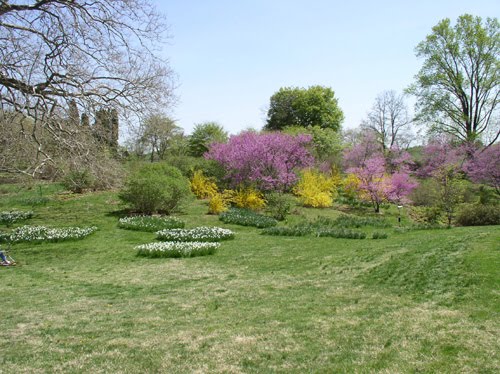
Winterthur in the Brandywine Valley near Philadelphia. Large expanses of lawn such as these are being turned into meadows with paths rambling through them.

We have covered an astronomical number of square miles with lawns, lawns that are in most cases deserts, useless to wildlife. That surface is comparable to that of Pennsylvania, New Jersey, Delaware, Maryland and Rhode Island combined.

If you live in the West you may prefer to see this surface as equivalent to that of the state of Washington.

Do we need that much lawn? Much of it could be turned to meadows or other plantings according to the mantra: "Less lawn, less mowing, less pollutants, more natives". This is being done in places such as the New River Gorge National Park Visitors Center in West Virginia. The meadows and grassy paths are pleasant to the eye, beneficial to wildlife and healthier for everybody.

New River Gorge Bridge Visitor Center. WV

Lawn for pollinators. Part I
Lawns for pollinators. Part III

List of articles

© Beatriz Moisset. 2012